
September 9, 2026 · Pregnancy
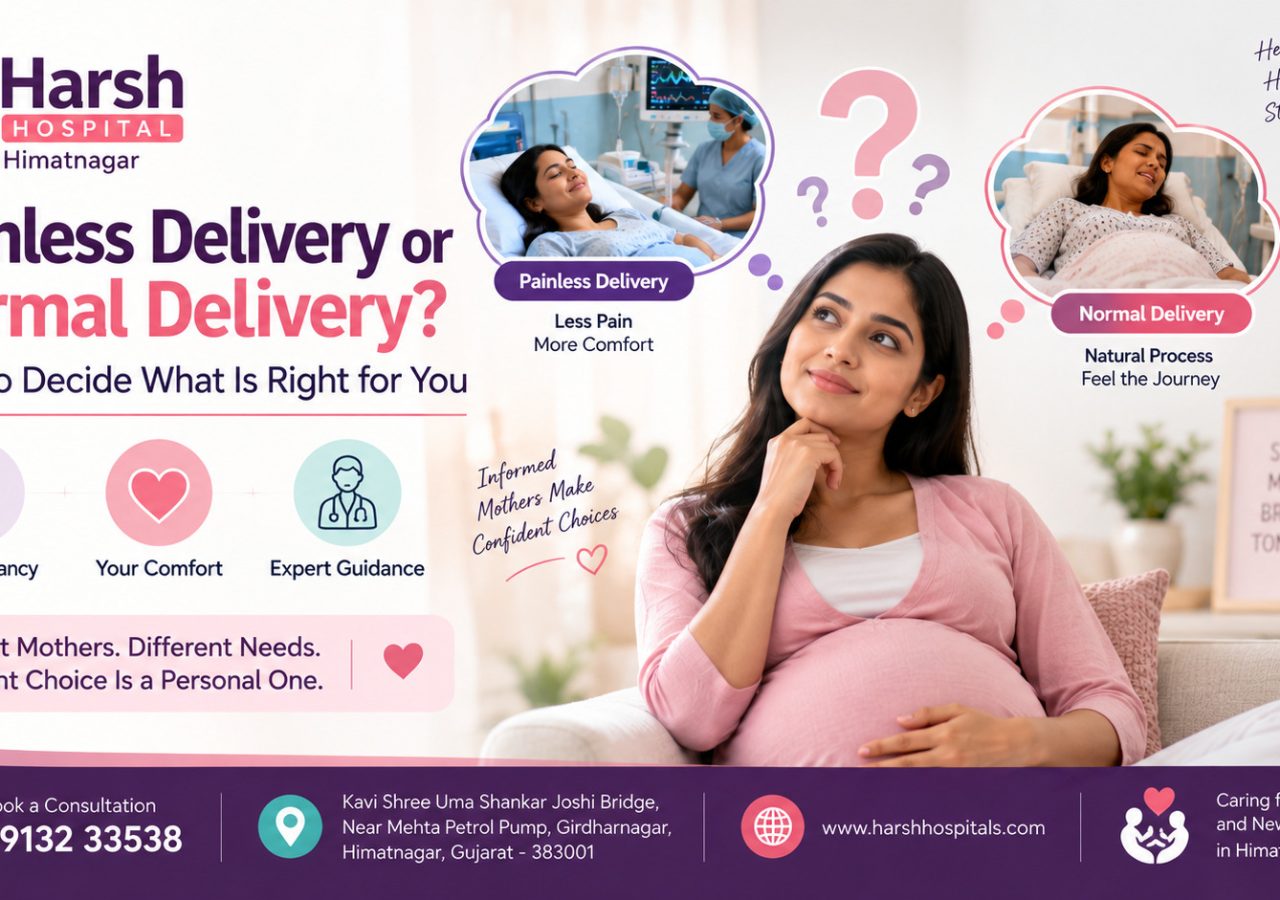
Choosing between Painless Delivery or Normal Delivery can be confusing for an expecting mother, particularly when there are questions about labour pain, epidural analgesia, safety and the possibility of a vaginal birth. In reality, there is no universally “best” choice. The appropriate approach depends on your pregnancy, medical history, labour progress, baby’s condition, pain preferences and advice from your obstetrician.
Medically Reviewed By
Dr. Hitesh A. Patel, MD, DGO
Gynecologist and Obstetrician, Harsh Hospital, Himatnagar
Medical review date: September 7, 2026
Table of Contents
1. The Real Difference Between the Two
2. Benefits and Trade-offs of Each
3. Advantages of painless delivery
4. When a natural, non-epidural birth suits you
5. What the Evidence Says About Safety
6. Questions to Ask Your Obstetrician
7. How We Guide the Choice at Harsh Hospital
8. Frequently Asked Questions
9. Talk to Our Maternity Team
The Real Difference Between the Two
The key point in understanding Painless Delivery or Normal Delivery is that the terms do not necessarily describe two completely different modes of birth.
A painless delivery usually refers to vaginal birth with labour pain relief, most commonly an epidural. A normal delivery generally refers to vaginal birth without surgical delivery. Therefore, an epidural can be used during a vaginal birth. In other words, painless delivery can still be a normal vaginal delivery.
This is an important distinction when considering the difference between painless and normal delivery. The primary difference is often the method of pain management rather than the route through which the baby is born.
For example, a mother may have a vaginal birth while receiving epidural analgesia. Another mother may have a vaginal birth using breathing, movement, relaxation, massage or other non-pharmacological methods.
The decision in Painless Delivery or Normal Delivery should therefore focus on safe childbirth, maternal comfort and individual circumstances rather than assuming one method is automatically superior.
Benefits and Trade-offs of Each
Understanding the benefits and limitations makes Painless Delivery or Normal Delivery easier to discuss with your obstetrician.
| Factor | Painless vaginal delivery | Vaginal delivery without epidural |
| Birth route | Vaginal | Vaginal |
| Main pain approach | Epidural or other medical analgesia | Natural coping methods and non-epidural measures |
| Pain intensity | Usually substantially reduced | Labour pain is experienced |
| Awareness | Mother remains awake and involved | Mother remains awake and involved |
| Mobility | May be reduced depending on technique and monitoring | Usually greater mobility |
| Monitoring | Additional monitoring may be required | Routine labour monitoring |
| Individual suitability | Depends on clinical assessment | Depends on clinical assessment |
Advantages of painless delivery
One of the major reasons women consider Painless Delivery or Normal Delivery is the ability to reduce labour pain while remaining awake for the birth.
Epidural analgesia can provide effective pain relief and may allow a mother to conserve energy during a prolonged labour. It may be particularly helpful when severe pain is causing distress or when the mother has difficulty coping despite supportive measures.
Potential advantages include:
- Significant reduction in labour pain.
- Better ability to remain calm and participate in labour.
- An option that can be adjusted as labour progresses.
- Continued pain relief that may also be useful if additional procedures become necessary.
However, painless delivery pros and cons should always be discussed. Epidural analgesia may cause temporary low blood pressure, difficulty passing urine, reduced leg sensation or other side effects. It may also affect mobility and require additional monitoring.
When a natural, non-epidural birth suits you
Some women prefer normal delivery without epidural because they want to remain mobile and use breathing, movement, relaxation, massage, positioning or continuous emotional support during labour.
For women considering epidural vs natural birth, the decision can be influenced by pain tolerance, previous birth experience, labour expectations, medical history and personal preferences.
A woman who is comfortable using non-medication techniques may prefer a vaginal birth without epidural. However, choosing an epidural later remains possible in many labour situations. Birth preferences should be flexible because labour can change unexpectedly.
What the Evidence Says About Safety
A common question is whether painless delivery is safe or not. Modern epidural analgesia is widely used and is considered an effective form of labour pain relief when administered appropriately and monitored by trained professionals.
The World Health Organization recommends epidural analgesia as an option for healthy pregnant women requesting pain relief during labour, depending on individual preferences.
The painless delivery pros and cons should still be explained before the procedure. Possible maternal effects include temporary low blood pressure, itching, difficulty passing urine, headache, fever or reduced movement in the legs. Serious complications are uncommon.
Evidence also does not support the idea that epidural pain relief automatically means a woman cannot have a vaginal birth. The American College of Obstetricians and Gynecologists states that neuraxial analgesia should be offered for labour pain relief and that its timing does not determine cesarean delivery risk.
Epidural analgesia is an established option for managing pain during labour when clinically appropriate. The World Health Organization’s recommendations on intrapartum care support offering epidural analgesia to healthy pregnant women who request pain relief, while recognising that the choice should take the woman’s preferences and individual clinical circumstances into account.
Questions to Ask Your Obstetrician
Before deciding between Painless Delivery or Normal Delivery, discuss your individual circumstances rather than relying only on family experiences or social media.
Useful questions include:
- Is my pregnancy currently low risk?
- Is an epidural appropriate for me?
- What pain relief options are available at the hospital?
- How might epidural analgesia affect movement and monitoring?
Asking these questions can help you understand which delivery is best for your specific pregnancy.
It is also useful to remember that a birth plan is a preference, not a guarantee. Maternal and fetal wellbeing remains the priority throughout labour.
How We Guide the Choice at Harsh Hospital
At Harsh Hospital in Himatnagar, discussions about Painless Delivery or Normal Delivery are based on the mother’s pregnancy status, clinical examination, antenatal history, fetal wellbeing and personal preferences.
Our maternity team explains the available choices before labour whenever possible. The discussion can include vaginal birth without epidural, epidural pain relief and cesarean delivery when medically indicated.
Harsh Hospital provides maternity care in Himatnagar, including antenatal care, normal pregnancy care, painless delivery and cesarean services.
Women searching for painless delivery Himatnagar can discuss epidural labour analgesia with the obstetric team. Similarly, women seeking normal delivery Himatnagar care can discuss strategies that support vaginal birth when clinically appropriate.
About Harsh Hospital
Harsh Hospital is a gynecology and maternity hospital in Himatnagar, Gujarat, led by Dr. Hitesh A. Patel, Gynecologist and Obstetrician. The hospital provides pregnancy care, maternity services, painless delivery, normal delivery support and other women’s health services.
Talk to Our Maternity Team
If you are still unsure about Painless Delivery or Normal Delivery, an antenatal consultation can help you understand your options before labour begins.
For women considering epidural delivery Himatnagar, our maternity team can explain how epidural analgesia works, what monitoring is required and whether it may be suitable for your pregnancy.
Call Harsh Hospital at +91 99132 33538 or book an appointment online at Harsh Hospital
A personalised discussion is the best way to understand which delivery is best for you and your baby.
Conclusion
The decision about Painless Delivery or Normal Delivery should not be based on fear, pressure or the experience of another mother. Both vaginal birth with pain relief and vaginal birth without epidural can be appropriate options when clinically suitable.
The most important factors are maternal and fetal safety, informed consent, appropriate monitoring and a birth plan that can adapt to changing circumstances. If you are considering Painless Delivery or Normal Delivery, discuss your expectations and medical history with your obstetrician well before labour.
For women seeking trusted maternity guidance in Himatnagar, Harsh Hospital provides pregnancy and delivery care with an emphasis on informed, respectful and individualised decision-making.
Disclaimer: This article is for general educational purposes and should not replace consultation with a qualified healthcare professional.
Frequently Asked Questions
1. Is painless delivery still a normal delivery?
Yes. Painless delivery usually refers to vaginal birth with medical pain relief such as an epidural. Therefore, Painless Delivery or Normal Delivery is not always a comparison between vaginal and surgical birth.
2. What is the main difference between painless and normal delivery?
The difference between painless and normal delivery is primarily the approach to labour pain management. Both can involve vaginal birth, but painless delivery commonly uses epidural analgesia.
3. Is painless delivery safe or not?
For appropriately selected patients, epidural analgesia is an established method of labour pain relief. Painless delivery is safe or not depends on individual medical factors, appropriate administration and monitoring.
4. Which delivery is best for every woman?
There is no single answer to which delivery is best. The safest approach depends on the mother, baby, pregnancy risk factors, labour progress and obstetric assessment.
5. Can I have normal delivery without epidural?
Yes. Normal delivery without epidural is possible for many women. Breathing, movement, relaxation, massage, supportive care and other pain management approaches may be used.
6. Does epidural mean I will need a cesarean?
No. Current evidence does not support the assumption that epidural analgesia automatically requires cesarean delivery. The delivery method depends on the overall clinical situation.
7. What are the pros and cons of painless delivery?
The main painless delivery pros and cons involve strong pain relief balanced against possible side effects such as temporary low blood pressure, reduced mobility, urinary difficulty or headache.
8. Can I change my mind during labour?
In many situations, yes. A woman’s pain relief preferences can change as labour progresses, although availability and clinical circumstances determine what options are appropriate at that time.