
08/12/2026 · women's hospital
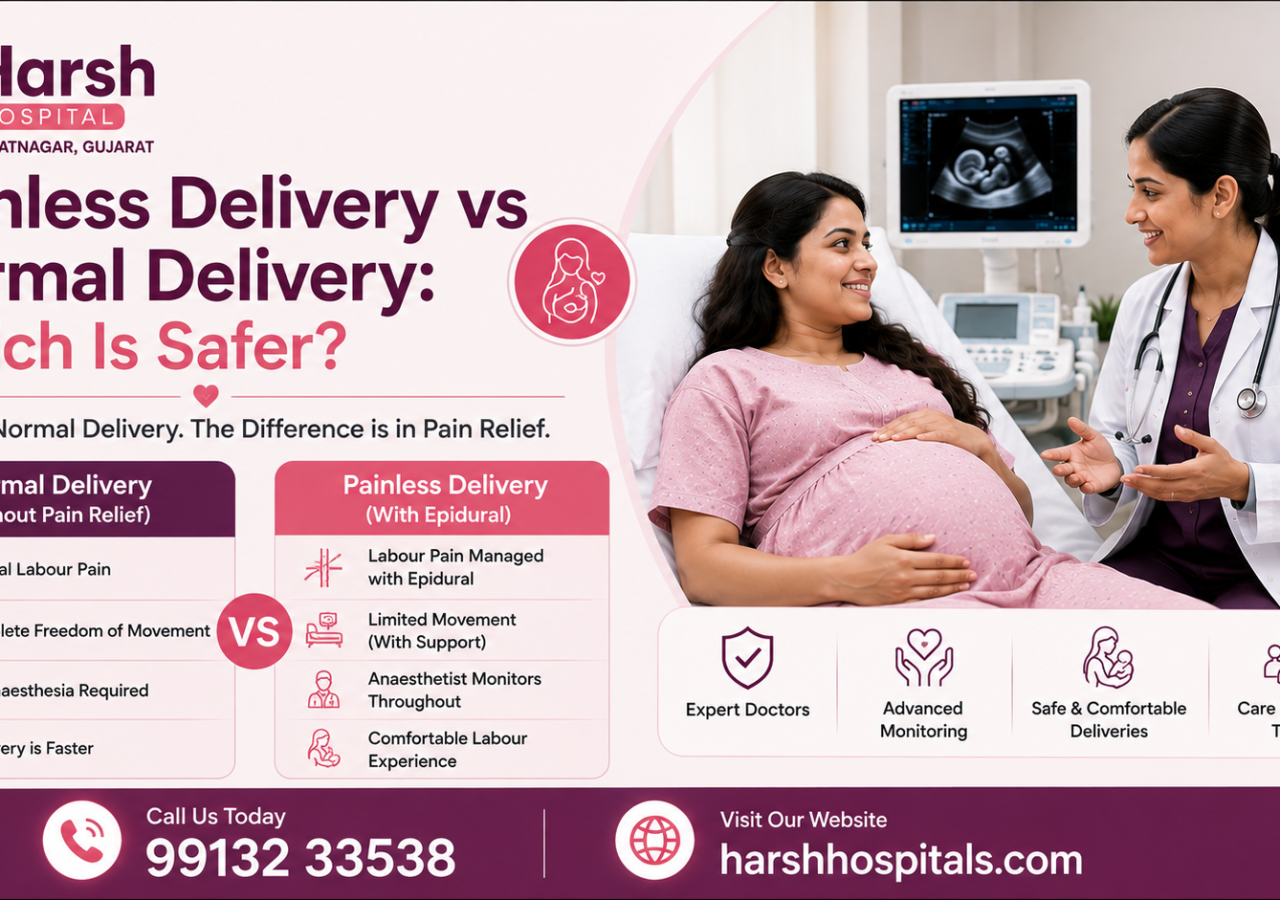
The way this question is usually asked contains a mistake, and the mistake matters. Families across Gujarat ask whether they should choose “painless delivery or normal delivery” as though these were two different routes of birth. They are not. A painless delivery is a normal delivery a vaginal birth through the birth canal with the labour pain controlled by an epidural. The baby arrives the same way. What changes is what the mother feels while it happens.
So the honest comparison is not between two kinds of birth. It is between a normal delivery with effective pain relief and a normal delivery without it. Framed that way, the safety question becomes answerable. This guide walks through what the evidence shows for the mother, for the baby, and for the labour itself. For the clinical detail of the procedure, see our full explainer on painless delivery vs normal delivery.
The Two Terms, Defined Properly
| Normal delivery (unmedicated) | Painless delivery (epidural) | |
| Route of birth | Vaginal | Vaginal — identical |
| Pain relief used | Breathing, positioning, support, sometimes injectable analgesics | Low-dose local anaesthetic through an epidural catheter in the lower back |
| Is the mother awake? | Yes | Yes — fully awake and alert |
| Can she push? | Yes | Yes — modern low-dose epidurals preserve the urge and the power to push |
| Can she move? | Freely | Limited; many units allow sitting up and position changes with support |
| Who is involved | Obstetrician and midwifery team | Obstetrician, midwifery team and an anaesthetist |
Is Painless Delivery Safe for the Mother?
Epidural analgesia in labour has been studied more thoroughly than almost any other obstetric intervention, across decades and tens of thousands of women. The broad conclusion from that body of evidence is reassuring: for a healthy mother in a properly staffed unit, an epidural is a safe way to manage labour pain, and it is the most effective one available.
That does not mean it is free of effects. The honest picture looks like this.
What the epidural genuinely does
- It provides far better pain relief than any alternative breathing techniques, injectable opioids or nitrous oxide. This is the least disputed finding in the literature.
- It lengthens the pushing stage modestly, typically by around fifteen to twenty minutes on average.
- It slightly increases the chance of an assisted vaginal birth with vacuum or forceps in some studies, though this effect has shrunk considerably with modern low-dose regimens.
- It causes a drop in blood pressure in some women, which is why an IV line is placed beforehand and blood pressure is monitored closely afterwards.
- It can cause shivering, itching, a mild fever or difficulty passing urine all manageable, all temporary.
What it does not do
- It does not increase your chance of a caesarean. This is the single most persistent myth about epidurals, and large reviews have consistently failed to find such an effect.
- It does not cause long-term back pain. Studies comparing women who had epidurals with those who did not find similar rates of backache months later. Pregnancy itself the weight, the posture, the ligament changes — is the usual culprit.
- It does not paralyse you. Serious neurological injury is exceptionally rare, on the order of one in tens of thousands of procedures.
- It does not mean you have “given up”. Pain tolerance is not a measure of a mother, and enduring avoidable agony confers no medical benefit on the baby.
Is Painless Delivery Safe for the Baby?
This is the concern that keeps most families awake, so it deserves a direct answer. The dose of local anaesthetic used in a labour epidural is small and is delivered into the epidural space around the spinal cord, not into the bloodstream. Very little reaches the baby.
The measurable outcomes reflect that. Babies born after an epidural have comparable Apgar scores at birth, and there is no established increase in admission to neonatal intensive care attributable to the epidural itself. Notably, epidurals are associated with less need for drugs to reverse opioid effects in the newborn than injectable opioid pain relief, because the mother has not needed those opioids.
There is one indirect effect worth understanding. If the mother develops a fever during a long epidural, the baby may be assessed for infection as a precaution which can mean blood tests, or occasionally antibiotics, that would not otherwise have happened. Your paediatric team will explain this if it arises.
Bottom line for the baby: a well-run epidural in a monitored labour room is not associated with worse newborn outcomes. Foetal heart monitoring continues throughout, which means problems are picked up sooner, not later.
Painless Delivery vs Normal Delivery: The Safety Comparison Table
| Safety factor | Normal delivery (unmedicated) | Painless delivery (epidural) |
| Caesarean rate | Baseline | No meaningful increase |
| Assisted delivery (vacuum/forceps) | Baseline | Slightly higher in some studies; reduced with low-dose regimens |
| Length of pushing stage | Baseline | Around 15–20 minutes longer on average |
| Maternal blood pressure | Stable | May fall; monitored and treated promptly |
| Maternal exhaustion in long labour | Higher risk | Substantially lower — the mother can rest |
| Newborn Apgar scores | Baseline | Comparable |
| NICU admission | Baseline | No established increase |
| Postpartum recovery of the perineum | Same | Same |
| Ability to breastfeed | Unaffected | Unaffected with modern regimens |
Recovery: Is There Any Difference Afterwards?
Surprisingly little, and this is worth stating clearly because families often expect a longer recovery from the “medical” option. Both are vaginal births, so the perineum heals the same way, the uterus contracts down on the same timeline, and bleeding follows the same pattern. Hospital stay is typically two days for both, occasionally a third if the epidural ran for a long labour.
The differences are short-lived. After an epidural your legs feel heavy for one to three hours, a urinary catheter may stay in until you can empty your bladder normally, and your first walk will be supervised. Against that, mothers who laboured with good pain relief often reach the postnatal ward less depleted, which can make the first night of feeding and settling the baby noticeably easier. By the second or third day, the two groups look much the same.
When Painless Delivery Is Actually the Safer Option
For some mothers an epidural is not simply a comfort choice it is the clinically preferable one, because uncontrolled pain itself carries risk. Your obstetrician may actively recommend it if you have:
- High blood pressure or pre-eclampsia severe labour pain raises blood pressure further, and good analgesia helps keep it controlled.
- Certain heart conditions, where the cardiovascular stress of unmanaged labour pain is best avoided.
- A long or difficult labour where exhaustion is the main threat to a vaginal birth.
- A twin pregnancy, where a working epidural allows rapid escalation if an intervention becomes necessary.
- A high likelihood of needing an assisted delivery or a rapid caesarean an epidural already in place can often be topped up for surgery, avoiding a general anaesthetic.
- Severe anxiety or a previous traumatic birth, where fear itself can slow labour.
Equally, an epidural is not suitable for everyone. Bleeding or clotting disorders, an infection at the injection site, certain spinal problems, very low platelet counts, or a labour that is simply too far advanced can all rule it out. That assessment belongs to your anaesthetist, ideally made well before you are in active labour one good reason to discuss your preferences during routine normal pregnancy care rather than on the day.
What Actually Determines Safety — For Both
Here is the part that gets lost in the debate. Whether or not you choose an epidural is a smaller determinant of your safety than where and with whom you deliver. Both a medicated and an unmedicated labour are safe under the same conditions, and both become risky without them:
- Continuous foetal heart monitoring during active labour, so distress is detected early.
- An obstetrician physically available, not merely reachable by phone.
- An anaesthetist on site around the clock if painless delivery is being offered at all.
- An operation theatre that can be ready within minutes if labour changes direction.
- Access to blood products and a neonatal team for the baby.
- Enough trained nursing staff that someone is genuinely watching you, not a monitor screen down the corridor.
Those six points are the real checklist, and they apply equally to both choices. If you are weighing up where to deliver, our maternity hospital checklist covers each of them in detail, and you can review the facilities available at a local normal delivery hospital before committing. Families in the surrounding belt can compare a normal delivery hospital in Vadali or consult a normal delivery specialist in Aravalli during the third trimester.
How to Decide, Without Deciding Too Early
You do not have to commit in advance, and it is usually a mistake to try. Labour is unpredictable: mothers who were certain they wanted an epidural sometimes find the pain manageable, and mothers who were adamantly against one change their minds at six centimetres. Neither is a failure.
What is worth doing in advance is the groundwork. Discuss it with your obstetrician in the third trimester so any medical contraindication is identified early. Confirm that your chosen hospital has a 24×7 anaesthetist, because an epidural service that only runs in office hours is not a service. Ask about the cost so it is not a shock. And then keep the decision open, so that on the day you can choose based on the labour you are actually having rather than the one you imagined.
One factor rarely discussed is the role of the birth partner. Continuous support through labour someone present, calm and attentive from admission to birth has a measurable effect on how women experience childbirth, and it works alongside pain relief rather than competing with it. Whoever accompanies you should know what you want, know what the hospital offers, and be willing to ask questions on your behalf at a moment when you will not feel like asking them yourself. Brief them properly in advance: where the labour room is, who to call, what your preferences are, and what circumstances would make you change your mind. A partner who already understands the plan is far more useful at two in the morning than one hearing it for the first time.
The safest birth is not the one with the least intervention or the most. It is the one where a skilled team is watching closely, the mother is supported, and the option to change course is available the moment it is needed.
Frequently Asked Questions
In painless delivery vs normal delivery, which is safer overall?
Both are safe for a healthy mother in a well-equipped unit, because they are the same route of birth. For mothers with high blood pressure, certain heart conditions, twins or a long exhausting labour, the epidural version is often the safer of the two.
Does an epidural increase the chance of a caesarean?
No. This is the commonest myth about painless delivery, and large reviews of the evidence have not found the epidural to raise caesarean rates. It may slightly increase the chance of a vacuum- or forceps-assisted vaginal delivery.
Will I still be able to push?
Yes. Modern low-dose epidurals are designed to block pain while preserving muscle power and the urge to push. Your team will guide your pushing, and the second stage may take slightly longer than it otherwise would.
Is the baby affected by the epidural drugs?
Very little of the drug reaches the baby. Apgar scores are comparable and there is no established increase in NICU admissions attributable to the epidural itself.
Can I decide during labour instead of before?
Usually yes, provided you are not too close to full dilatation and there is no medical reason against it. Discussing it beforehand simply means nothing has to be worked out from scratch while you are in pain.
Does painless delivery affect breastfeeding?
Modern low-dose regimens are not considered to interfere with establishing breastfeeding. Early skin-to-skin contact and good lactation support matter far more.