
07/31/2026 · women's hospital
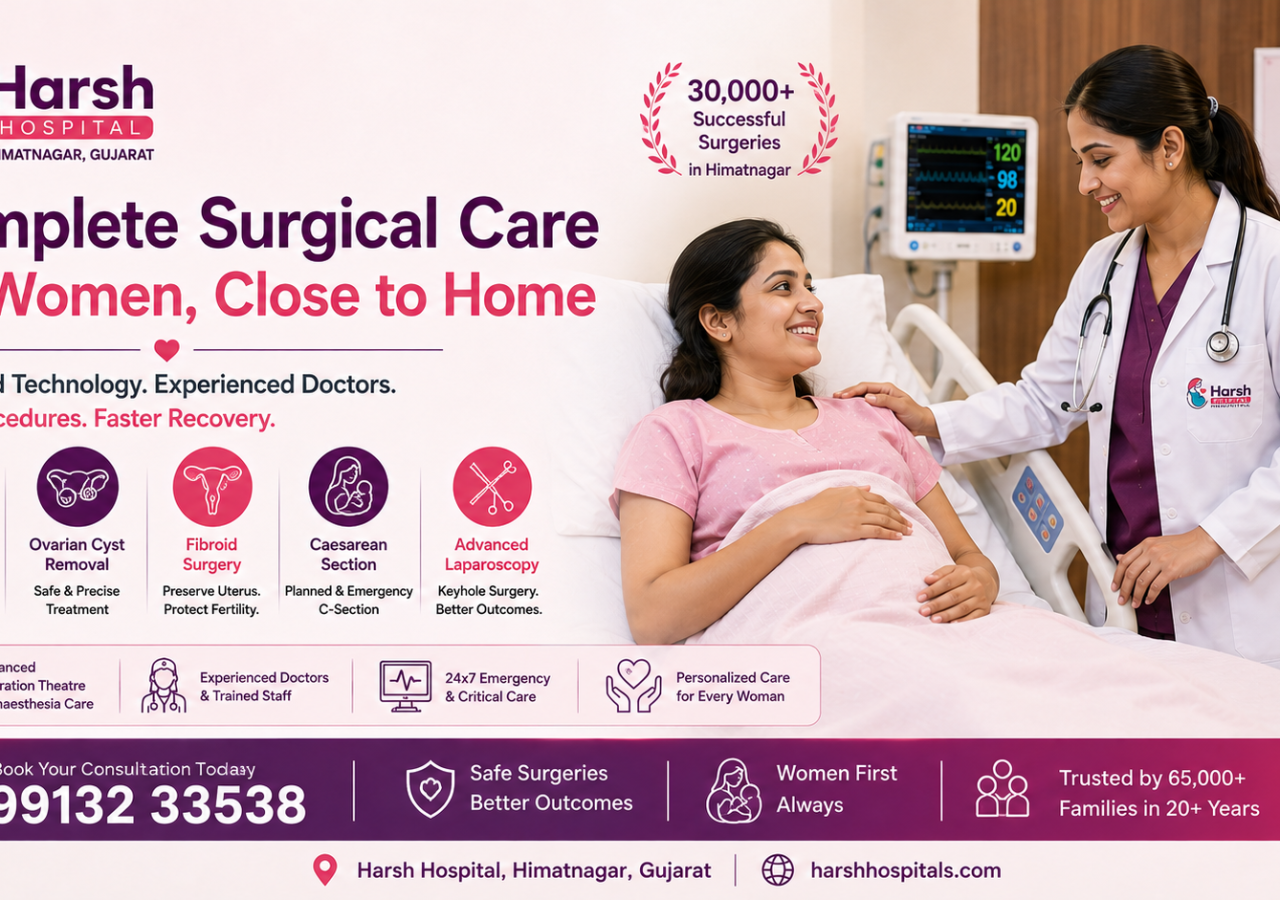
The word “surgery” makes most people freeze. That reaction is normal, and it is also why so many women delay treatment for fibroids, cysts or endometriosis until the problem becomes urgent. A well-run surgical hospital in Himatnagar exists to make that decision less frightening, not more. Modern keyhole techniques mean many procedures now involve a two-day stay rather than two weeks in bed. Our related read on how surgical hospitals improve maternal and neonatal safety explains why the setup of the hospital matters as much as the operation itself.
Quick answer: A complete surgical hospital in Himatnagar should offer laparoscopic hysterectomy, ovarian cyst removal, fibroid surgery, endometriosis surgery, hysteroscopy, caesarean section, ectopic pregnancy surgery, tubal procedures, cervical treatments and emergency obstetric surgery — all with in-house anaesthesia, sterile theatre facilities and post-operative monitoring.
Table of Contents
- What Counts as a Complete Surgical Hospital in Himatnagar
- 10 Treatments a Women’s Surgical Hospital in Gujarat Should Offer
- Open Surgery vs Laparoscopy: What Actually Changes
- How Safety Is Built Into a Surgical Hospital
- What Your Surgical Journey Looks Like, Step by Step
- Cost, Insurance and Day-Care Surgery
- Honest Pros and Cons of a Local Surgical Hospital
- Preparing for Surgery: A Practical Seven-Day Countdown
- Emergencies: Why Distance Decides Outcomes
- Questions Worth Asking Before Any Operation
- Choosing the Right Surgical Hospital in Himatnagar
- Frequently Asked Questions
What Counts as a Complete Surgical Hospital in Himatnagar
Plenty of clinics perform minor procedures. Far fewer can handle a planned operation and an emergency on the same night. That gap is the whole point of the word “complete.”
Four things separate the two.
- A dedicated sterile theatre with proper air handling, not a converted procedure room
- Anaesthesia cover available for planned lists and emergencies
- Post-operative monitoring by trained nursing staff, not family members
- Blood arrangement and resuscitation equipment ready before the first incision
Ask about all four. A capable surgical hospital will answer without pausing. Harsh Hospital has completed over 30,000 surgeries in Himatnagar, and that volume is what keeps the routine sharp.
10 Treatments a Women’s Surgical Hospital in Gujarat Should Offer
Here is what a genuinely complete women’s surgical hospital in Gujarat handles day to day.
- Total laparoscopic hysterectomy. Removal of the uterus through small keyhole cuts. Shorter stay, less pain, faster return to work. Read more on laparoscopic hysterectomy.
- Ovarian cyst removal. Most cysts are harmless. Persistent, large or painful ones need removal, ideally with the ovary preserved. See our ovarian cyst surgery
- Myomectomy for fibroids. Fibroids are removed while the uterus stays intact, which matters when you still want children.
- Endometriosis surgery. Careful removal of tissue causing severe pain and infertility. Our endometriosis surgery approach focuses on preserving fertility.
- Diagnostic and operative hysteroscopy. A camera inside the uterus finds and treats polyps, adhesions and abnormal bleeding without any external cut.
- Caesarean section. Planned and emergency, with the theatre next to the labour room. See how we handle a cesarean section.
- Ectopic pregnancy surgery. A true emergency. Speed here saves lives, which is why local access matters.
- Tubal surgery and sterilisation. Both permanent contraception and, in selected cases, tubal assessment during fertility workup.
- Cervical procedures. Treatment of abnormal cervical changes picked up on screening, done early and simply.
- Prolapse repair. Pelvic floor surgery for women with dropping of the uterus or bladder, common after multiple deliveries.
Not every case needs an operation. Roughly, a good surgical hospital talks a fair number of patients out of surgery each week and offers medical management instead.
Open Surgery vs Laparoscopy: What Actually Changes
This is the question patients ask most, so here is the plain comparison.
Laparoscopy, the keyhole route
- Three or four cuts, each under a centimetre
- Usually one to two nights in hospital
- Less blood loss and less post-operative pain
- Return to light work in about one to two weeks
- Smaller scars and lower infection risk
Open surgery, the traditional route
- One larger cut across the lower abdomen
- Typically four to six nights in hospital
- Recovery of four to six weeks before normal activity
- Still the safer choice for very large masses, dense adhesions or suspected cancer
So laparoscopy is not automatically better. It is better for most cases. A surgeon who offers both, and explains why one suits your anatomy, is more trustworthy than one who only ever does the same thing. Costs differ too, and our laparoscopic surgery cost guide breaks down what changes the final number.
How Safety Is Built Into a Surgical Hospital
Safety is not a feeling. It is a set of habits repeated every single time.
The WHO estimates that a significant share of surgical complications are preventable, and its Surgical Safety Checklist exists precisely for that reason. You can read the background on the WHO’s patient safety fact sheet.
In practice, a good surgical hospital in Himatnagar will:
- Confirm your identity, the procedure and the side before anaesthesia
- Run a pre-anaesthetic check, including blood tests, ECG where needed and a review of your medicines
- Give antibiotics at the correct time, usually within an hour of the incision
- Count instruments and swabs before closing
- Monitor you in recovery until you are fully awake and stable
- Give written discharge instructions, not verbal advice you will forget
Ask to see the discharge summary format before your surgery. It tells you a lot about how organised the place is.
Have a report suggesting surgery? Bring it in for a straight second opinion before you decide. Book a consultation with Dr. Hitesh Patel or call 99132 33538.
What Your Surgical Journey Looks Like, Step by Step
Knowing the sequence removes most of the fear. Here is the usual path.
- Consultation and diagnosis. History, examination, ultrasound and relevant blood tests. The problem is named clearly.
- Discussion of options. Medicine, waiting, or surgery. You should hear what happens if you choose nothing.
- Pre-operative workup. Blood group, haemoglobin, sugar, ECG and a physician check if you have other conditions.
- Written estimate and consent. Costs, risks and expected recovery, all explained before you sign.
- Admission and fasting. Usually the evening before or early on the morning of surgery.
- The operation. Anaesthesia, the procedure itself, then recovery room monitoring.
- First 24 hours. Pain control, early walking, and fluids started as soon as it is safe.
- Written instructions, medicines, warning signs to watch for, and a follow-up date.
- Follow-up. Stitch or wound check at about a week, then a longer review at four to six weeks.
Early walking is the step patients most often resist and the one that most reduces complications. Push through it.
Cost, Insurance and Day-Care Surgery
Surgical costs in Gujarat vary with the procedure, the surgical route, room category and length of stay. Complications add to that, which is why an itemised estimate matters more than a headline package price.
A few practical points:
- Keyhole surgery often costs less overall once the shorter stay and faster return to work are counted, even when the operating fee is higher.
- Many procedures are now day-care, meaning you go home the same evening.
- Check your insurance waiting period. Several policies exclude fibroid and hernia surgery for the first two to four years.
- Ask what is excluded. Implants, extra investigations and additional stay days are commonly billed separately.
- Public schemes may apply. The Ministry of Health and Family Welfare lists national health insurance schemes many families qualify for.
Honest Pros and Cons of a Local Surgical Hospital
Where local care wins
- Emergency access measured in minutes, which matters for ectopic pregnancy or post-partum bleeding
- Family can stay nearby, which genuinely speeds recovery
- Lower total cost once travel, food and lost wages are counted
- Follow-up is easy, so small problems get caught early
Where a larger centre may suit better
- Suspected gynaecologic cancer needing an oncology team
- Complex cases requiring several specialities at once
- Very rare procedures performed only at tertiary centres
A trustworthy women’s surgical hospital in Gujarat will refer you onward when that is the right call. Willingness to let a patient go is a genuine quality marker.
Preparing for Surgery: A Practical Seven-Day Countdown
Good preparation shortens recovery. Here is what the week before usually looks like at a surgical hospital in Himatnagar.
- Day 7. Pre-operative tests done. Blood group, haemoglobin, sugar, ECG and any physician clearance you need.
- Day 5. Medicine review. Blood thinners, diabetes tablets and certain supplements may need adjusting or stopping.
- Day 4. Stop smoking if you have not already. Even a few days helps wound healing and lung function.
- Day 3. Arrange help at home. Someone to manage cooking and children for the first week makes a real difference.
- Day 2. Confirm the estimate, insurance paperwork and admission time. Pack loose clothing and slippers with a back.
- Day 1. Follow the fasting instruction exactly. Usually nothing to eat after midnight, with sips of water allowed as advised.
- Surgery day. Bathe, skip jewellery and makeup, bring all reports, and bring one attendant who can stay.
Small things matter here. Loose clothing that does not press on the wound, for example, saves you real discomfort on day two.
Emergencies: Why Distance Decides Outcomes
Planned surgery gives you time to choose. Emergencies do not.
Ectopic pregnancy, ovarian torsion and heavy bleeding after delivery all become dangerous within hours. In those situations, the nearest capable surgical hospital in Himatnagar is simply better than a superior hospital three hours away. Travel time is part of the treatment.
So even if you plan major procedures elsewhere, know where your nearest fully equipped theatre is. Keep the number saved. Most families never need it, and the ones who do rarely have time to search.
Questions Worth Asking Before Any Operation
Take this list with you.
- What exactly is the diagnosis, and how certain are you?
- What happens if I wait six months?
- Will this be keyhole or open, and why?
- How many of these do you perform each year?
- Who gives the anaesthesia, and what is their experience?
- How long in hospital, and how long off work?
- What are the three most likely complications?
- What does the estimate include, and what is extra?
- Can I get a second opinion first?
Any surgeon worth trusting will welcome all nine questions.
Choosing the Right Surgical Hospital in Himatnagar
Skill, setup and honesty. Those three decide your outcome far more than the size of the building. A surgical hospital in Himatnagar that operates regularly, keeps anaesthesia and recovery support in-house, and tells you when surgery is not needed is the one worth choosing.
Harsh Hospital has built that record over two decades and 30,000 procedures, focused entirely on women’s health. If you are holding a scan report and a difficult decision, do not sit on it. Book an appointment or call 99132 33538, and get a clear, unhurried explanation of your options.
Frequently Asked Questions
What treatments does a surgical hospital in Himatnagar offer?
Laparoscopic hysterectomy, ovarian cyst removal, fibroid surgery, endometriosis surgery, hysteroscopy, caesarean section, ectopic pregnancy surgery, tubal procedures, cervical treatments and prolapse repair.
Is laparoscopic surgery safer than open surgery?
For most gynaecological conditions, yes. It causes less blood loss, less pain and a shorter stay. Open surgery remains safer for very large masses, dense adhesions or suspected cancer.
How long does recovery take after keyhole surgery?
Most women go home within one to two days and return to light activity in one to two weeks. Full recovery, including heavy lifting, usually takes four to six weeks.
Do I need to stop my regular medicines before surgery?
Some, yes. Blood thinners, certain diabetes medicines and some supplements need adjusting. Bring your full medicine list to the pre-operative visit and follow the written instruction.
Can fibroids be removed without removing the uterus?
Often, yes. A myomectomy removes the fibroids and preserves the uterus. Suitability depends on the number, size and position of the fibroids.
Will insurance cover gynaecological surgery?
Usually, though many policies have a waiting period of two to four years for conditions such as fibroids. Check your policy document and inform the hospital’s desk early.
Is a second opinion reasonable before surgery?
Always. For any major operation, a second opinion is standard practice. A confident surgeon will not object and may even suggest it.
Where is Harsh Hospital located?
Near Mehta Petrol Pump, Himatnagar HO-383001, Gujarat. Open Monday to Saturday, 9:00 AM to 8:00 PM, with emergency cover on Sundays.