
09/18/2026 · laparoscopic surgery
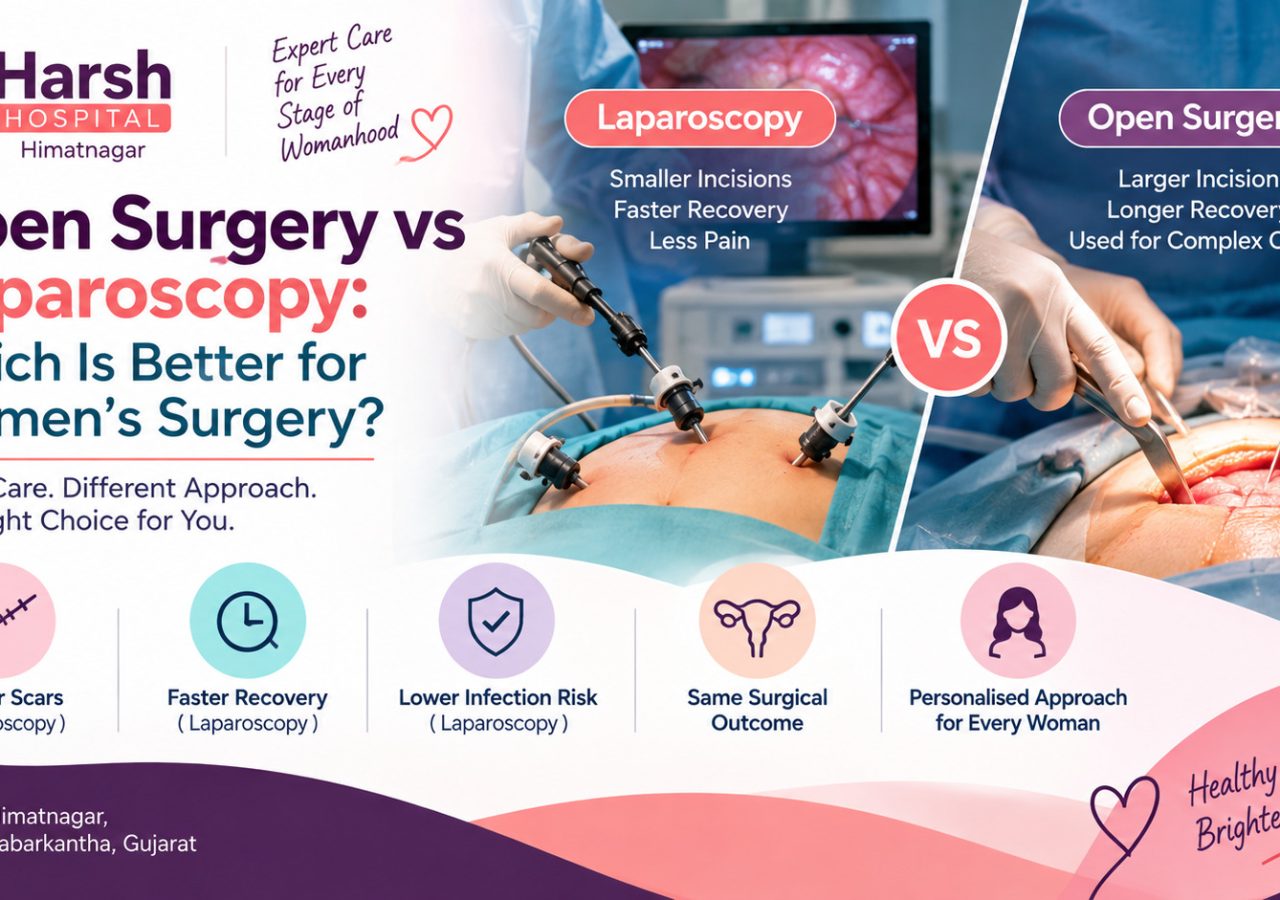
Laparoscopy is usually preferred for routine gynaecological operations: 3 or 4 incisions of 0.5 to 1.2 cm, a 1 to 2 day hospital stay and 2 to 3 weeks to normal activity. Open surgery remains safer with a very large uterus, dense adhesions, suspected cancer or emergency bleeding. The condition decides, not the technique.
That is the short answer to open surgery vs laparoscopy. The longer one depends on your diagnosis, your anatomy and your surgeon’s experience. If you have been offered a choice between the two, this comparison covers what actually differs, and you can read more about the treatments available alongside it.
Open Surgery vs Laparoscopy: What Is the Difference?
Open surgery, sometimes called conventional surgery or laparotomy, uses a single incision of roughly 10 to 15 cm through the abdominal wall. The surgeon sees and handles the organs directly.
Laparoscopy, the main form of minimally invasive surgery in gynaecology, uses several small ports. Carbon dioxide inflates the abdomen to create working space, a camera provides vision on a screen, and long instruments pass through the ports. In laparoscopy vs open surgery, nothing about the operation inside changes. Only the access does.
Hysteroscopy is a third route worth knowing about. For conditions inside the uterine cavity, such as submucosal fibroids or polyps, a telescope passes through the cervix with no abdominal incision at all.
The comparison of open surgery vs laparoscopy is therefore not a comparison of two different operations. It is a comparison of two ways to reach the same organs, with different trade-offs in recovery, visibility and control.
Open Surgery vs Laparoscopy: Comparison Table
| Factor | Laparoscopy | Open surgery |
| Incision | 3 to 4 ports, 0.5 to 1.2 cm | One incision, 10 to 15 cm |
| Hospital stay | 1 to 2 days typically | 4 to 6 days typically |
| Return to normal activity | About 2 to 3 weeks | About 4 to 6 weeks |
| Blood loss | Generally lower | Generally higher |
| Wound infection risk | Lower | Higher |
| Adhesion formation | Generally less | Generally more |
| Operating time | Often longer | Often shorter |
| Scarring | Several small scars | One larger scar |
| Tactile feedback for surgeon | Limited | Direct |
| Anaesthesia | General only | General or regional |
| Best suited to | Routine, accessible pathology | Large masses, adhesions, suspected cancer, emergencies |
Ranges above are typical for laparoscopy advantages and open surgery alike, and vary with the operation, your anatomy and your general health. Your surgeon should give you figures specific to your case.
What Are the Benefits of Laparoscopy Over Open Surgery?
The benefits of laparoscopy in open surgery vs laparoscopy are mostly about recovery rather than the surgical result. Smaller wounds mean less post-operative pain, fewer wound infections, and a faster return to work and family life.
Blood loss is generally lower in laparoscopic vs conventional surgery, partly because the camera magnifies the operative field and small vessels are seen clearly. Adhesion formation tends to be less, which matters for future fertility and for any later surgery. These benefits of laparoscopy compound over time.
Cosmetic outcome is a real consideration in keyhole vs open surgery, though rarely the deciding one. Several 1 cm scars heal differently from a single 12 cm scar, and this is often what patients notice first about keyhole vs open surgery.
There is a cost to these laparoscopy advantages, and any honest account of laparoscopic vs conventional surgery includes it. Operating time is often longer, the surgeon loses direct touch, and entry into the abdomen carries its own small risk of injury to bowel or blood vessels. The Royal College of Obstetricians and Gynaecologists publishes specific guidance on safe laparoscopic entry for this reason.
Open Surgery vs Laparoscopy: When Is Open the Better Choice?
Open surgery is not an outdated option. In laparoscopic vs conventional surgery terms, it is the correct option in defined situations, and a surgeon who never recommends it is not individualising care.
A very large uterus or a large pelvic mass leaves little working space once carbon dioxide is introduced. Attempting minimally invasive surgery in that setting can mean poor visibility and harder bleeding control.
Dense adhesions from previous surgery, pelvic infection or radiotherapy make safe port entry difficult, because normal anatomy is distorted and bowel may be stuck to the abdominal wall.
Suspected malignancy often favours open surgery so that tissue can be removed intact rather than cut into pieces. Emergency bleeding, such as a ruptured ectopic pregnancy with instability, usually needs the speed and direct control of an open approach.
Significant heart or lung disease is a further factor. Pneumoperitoneum raises abdominal pressure, which affects breathing and circulation and may be poorly tolerated.
How Does Recovery Compare in Open Surgery vs Laparoscopy?
After laparoscopy most women walk within hours, go home in 1 to 2 days, and return to desk work at around 2 weeks. Shoulder tip pain from residual carbon dioxide is common for 2 to 3 days and settles without treatment.
After open surgery, expect 4 to 6 days in hospital, more wound pain, and lifting restrictions for about 6 weeks. Return to work is typically 4 to 6 weeks and longer for physical jobs.
Both routes share the same warning signs. Fever, worsening pain, heavy bleeding, wound redness or discharge, difficulty passing urine or persistent vomiting all warrant contact with your surgical team rather than waiting for a scheduled review.
Laparoscopy advantages extend to driving, though advice differs by insurer and by operation. The practical test is whether you can perform an emergency stop without hesitating because of pain.
Open Surgery vs Laparoscopy for Common Gynaecological Conditions
For hysterectomy, the open surgery vs laparoscopy answer generally favours laparoscopic or vaginal routes when the uterus is a suitable size. Total laparoscopic hysterectomy shortens stay and recovery considerably.
For ovarian cysts, laparoscopy is usually the standard approach for benign-appearing cysts, allowing removal of the cyst while preserving healthy ovarian tissue. Ovarian cyst surgery is one of the clearest examples in keyhole vs open surgery where the minimally invasive route suits the pathology.
For endometriosis, laparoscopy is both diagnostic and therapeutic, and magnification helps identify deposits that are hard to see otherwise. Endometriosis surgery is usually performed this way in experienced hands.
For fibroids, open surgery vs laparoscopy depends on size, number and position. Fewer, smaller, accessible fibroids suit laparoscopy. Many large or deep fibroids may be safer open, particularly when uterine repair quality matters for future pregnancy.
For ectopic pregnancy, laparoscopy vs open surgery favours the keyhole route when the patient is stable. Instability changes the answer immediately.
When Neither Operation Is the Right Answer
This is the part that gets left out of most open surgery vs laparoscopy comparisons, and it applies to a meaningful number of women.
Small asymptomatic fibroids and simple ovarian cysts under about 5 cm in premenopausal women are frequently managed with observation. A scan finding alone is not an indication for surgery.
Heavy menstrual bleeding often responds to medical treatment. NICE sets out a stepwise approach beginning with an intrauterine system or tranexamic acid before surgical options are considered.
If you are close to menopause and symptoms are manageable, waiting may avoid an operation entirely, since fibroids commonly shrink as oestrogen falls.
Be cautious if either arm of open surgery vs laparoscopy is recommended without any discussion of non-surgical options, or if you are asked to decide the same day outside an emergency. A week to consider is reasonable and rarely changes the outcome.
Talking Open Surgery vs Laparoscopy Through With a Specialist
If you have been offered a choice between open surgery vs laparoscopy, bring your scan reports and ask the questions that matter: why this operation, why this route, what the alternatives are, and what happens if it is not straightforward. Dr. Hitesh A. Patel at Harsh Hospital, Himatnagar, has over 20 years of experience in gynaecology and advanced laparoscopy. You can book an appointment or read more about the team.
Frequently Asked Questions
Is laparoscopy always better than open surgery?
No. In open surgery vs laparoscopy, the keyhole route generally means less pain, a shorter stay and faster recovery, but open surgery is safer with a very large uterus, dense adhesions, suspected cancer or emergency bleeding. The condition and your anatomy decide.
How long does recovery take in laparoscopy vs open surgery?
After laparoscopy, most women return to routine activity in about 2 to 3 weeks with a 1 to 2 day hospital stay. After open surgery, expect 4 to 6 days in hospital and 4 to 6 weeks before normal activity.
Is laparoscopy more painful than expected?
Wound pain is usually less, but shoulder tip pain from residual carbon dioxide surprises many women. It typically lasts 2 to 3 days, is not dangerous, and settles without specific treatment as the gas is absorbed.
Can laparoscopic surgery become open surgery mid-procedure?
Yes, and in open surgery vs laparoscopy this is a safety decision rather than a complication. Bleeding, unexpected adhesions or poor visibility may make conversion the safer choice. Ask your surgeon what their conversion rate is for your operation.
Does minimally invasive surgery affect future fertility?
Generally it is favourable, since less adhesion formation is expected. For fibroid surgery, the quality of uterine repair matters more than the route. Discuss fertility plans before surgery so the approach can be chosen accordingly.
Which is cheaper in open surgery vs laparoscopy?
Costs vary widely by hospital and city. Laparoscopy often carries higher theatre and consumable costs but a shorter stay, so the totals can be closer than expected. Ask for an itemised estimate from any provider.
Do I need general anaesthesia for laparoscopy?
Yes. Laparoscopy requires general anaesthesia because the abdomen is inflated with carbon dioxide and breathing must be controlled. Open surgery can sometimes be performed under spinal or epidural anaesthesia instead.
Medical Disclaimer
This article provides general information and does not replace individual medical advice. The right surgical approach depends on your diagnosis, imaging, medical history and examination. Please discuss your options with a qualified gynaecologist or surgeon.