07/28/2026 · maternity hospital
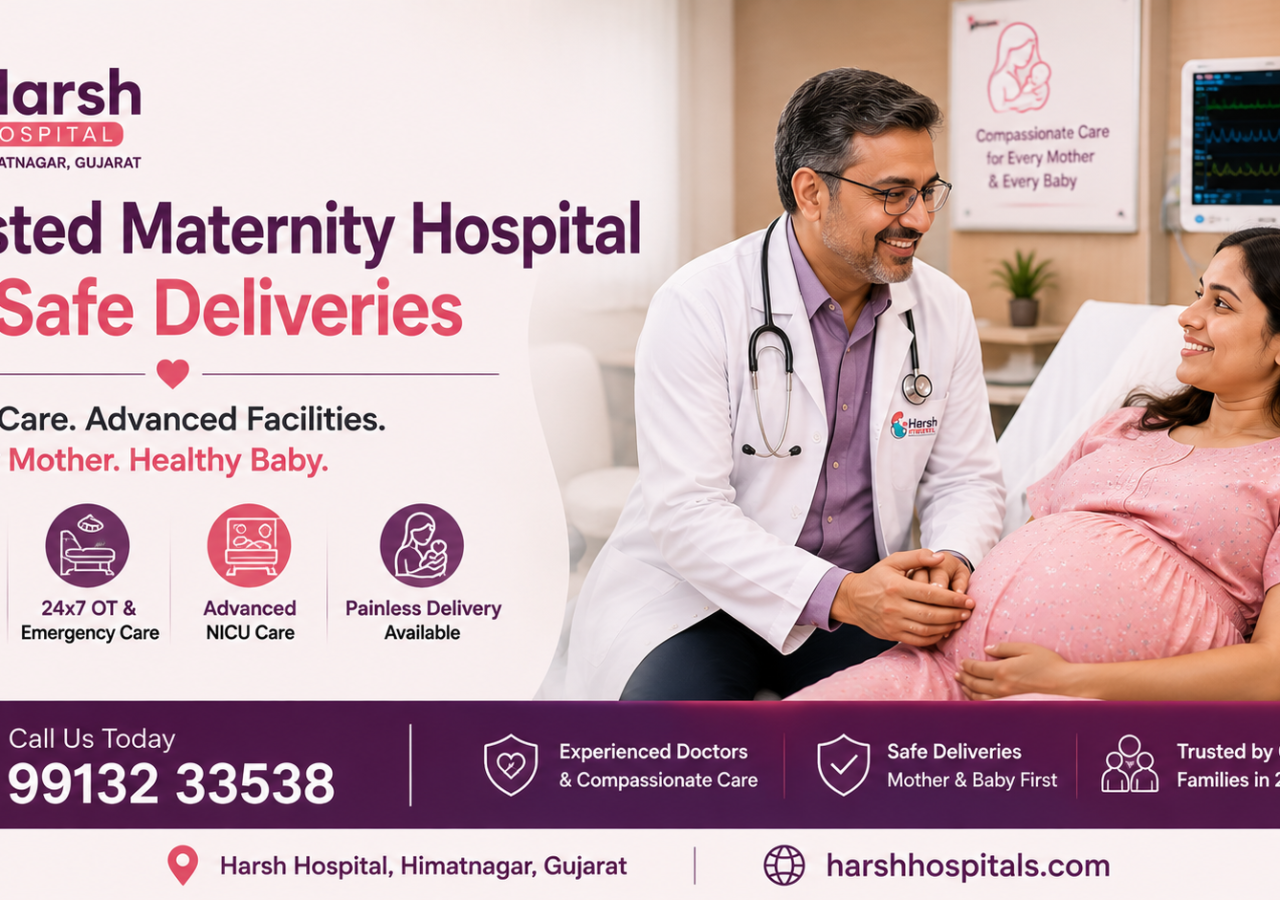
Picking a maternity hospital is not like picking a clinic for a fever. You are choosing the room where your baby takes a first breath. You are also choosing the team that stands beside you if the plan changes at 3 a.m. Harsh Hospital in Himatnagar has supported more than 65,000 safe deliveries across two decades, and families keep coming back for the same three reasons: an experienced obstetrician who answers the phone, a theatre that stays ready, and plain-language answers instead of jargon. If you are still comparing options, our practical checklist for choosing a maternity hospital is a good place to start.
Quick answer: A safe delivery depends on four things working together – an experienced obstetrician available round the clock, an operation theatre that can start a caesarean within minutes, anaesthesia and blood support in the same building, and newborn care right beside the labour room. Harsh Hospital brings all four under one roof in Himatnagar, so no mother has to be shifted mid-labour.
Table of Contents
- What Safe Delivery Really Means in a Maternity Hospital
- 9 Reasons Harsh Hospital Works as a Trusted Maternity Hospital
- Why Families Pick This Maternity Hospital in Sabarkantha
- Mother and Child Hospital vs General Hospital: The Real Difference
- Your Pregnancy Journey Here, Step by Step
- Honest Pros and Cons of Choosing Us
- Two Situations We See Almost Every Week
- How to Judge Any Maternity Hospital Before You Book
- Cost, Insurance and Government Support
- The Real Answer on Choosing a Maternity Hospital
- Frequently Asked Questions
What Safe Delivery Really Means in a Maternity Hospital
Most families judge a hospital by its waiting area. That is understandable, but it tells you very little. Safety in childbirth is mostly about time. How fast can the team move when the baby’s heart rate drops? How quickly can an anaesthetist reach the table?
Because most births go smoothly, these questions feel theoretical. Then, in a small share of cases, everything depends on them. The World Health Organization notes that most maternal deaths are preventable with timely, skilled care, which is exactly why response time matters more than decor. You can read more on the WHO’s maternal health page.
So here is a simple way to think about it. A good maternity hospital shortens the distance between “something is wrong” and “we are already fixing it.”
Three timings worth asking about
- Decision-to-incision time. How long from the doctor deciding on an emergency caesarean to the first cut? Under 30 minutes is the standard many teams work toward.
- Anaesthetist response. Is one on site, or on call from home 20 minutes away?
- Blood availability. Can the hospital arrange matched blood quickly if bleeding starts after delivery?
Ask these three questions anywhere you visit. The answers tell you more than any brochure.
9 Reasons Harsh Hospital Works as a Trusted Maternity Hospital
Rather than list every facility, here is what actually changes the experience for mothers who deliver here.
- One senior doctor stays with your case. Hitesh Patel has over 20 years in obstetrics and gynaecology. You are not handed to a different registrar every visit, so nothing gets lost between appointments.
- Emergency caesarean capability in-house. The theatre and the labour room sit in the same building. Nobody gets shifted across town during an emergency.
- Painless labour is offered, not pushed. Epidural analgesia is available if you want it. Read how painless delivery works before you decide.
- High-risk pregnancies get a written plan. Diabetes, high blood pressure, twins, a previous caesarean – each gets a monitoring schedule. See our approach to high-risk pregnancy
- Normal delivery stays the first goal. Surgery is a tool, not a default. We explain why a cesarean section is being recommended, every time.
- Scans and reports are read the same day. No week-long wait wondering what a growth scan means.
- Costs are discussed early. You get an estimate before admission, not a surprise at discharge.
- Same-day appointments. Pregnancy worries rarely wait a week for a slot.
- Follow-up continues after discharge. Feeding trouble, stitch pain, low mood – these get seen, not brushed aside.
None of this is dramatic. Still, small things done consistently are what a safe birth actually looks like.
Why Families Pick This Maternity Hospital in Sabarkantha
Distance matters more than people admit. Labour does not schedule itself around traffic. For a family in Idar, Prantij or Talod, a hospital 20 minutes away beats a big-city name three hours away – as long as the local hospital can handle emergencies.
That is the real argument for a good maternity hospital in Sabarkantha. You keep the response time short. You also keep your support system close, which matters more than most people expect during a long labour.
We regularly see families who booked in Ahmedabad, then switched back after two or three trips. The travel wore them down. Meanwhile, a maternity hospital in Sabarkantha that offers the same core capabilities removes that strain entirely.
When travelling further does make sense
Honesty helps here. Some situations genuinely need a larger centre:
- Babies with a diagnosed heart defect needing surgery soon after birth
- Very early preterm delivery, roughly before 30 weeks
- Rare maternal conditions requiring a specialist team
In those cases, we say so plainly and help arrange the referral. A maternity hospital in Sabarkantha that pretends to handle everything is not being kind to you.
Mother and Child Hospital vs General Hospital: The Real Difference
A general hospital treats everything. A mother and child hospital does one family of things repeatedly, which builds a different kind of muscle memory.
What a mother and child hospital does better
- Staff who read a CTG trace dozens of times a week, not occasionally
- Nurses trained specifically in labour support and newborn handling
- Infection control shaped around newborns rather than general wards
- Feeding help from someone who does it daily
Where a general hospital still wins
- Complex trauma or unrelated medical emergencies
- Patients needing several specialties at once, such as cardiology plus obstetrics
For a straightforward or moderately complex pregnancy, though, a focused mother and child hospital is usually the better fit. Our detailed comparison of a mother and child hospital covers scans and delivery costs in more depth.
Your Pregnancy Journey Here, Step by Step
Knowing the sequence removes a lot of anxiety. Here is roughly how it runs.
- First visit (before 12 weeks). Confirmation scan, blood tests, blood pressure, weight, medical history. You leave with a due date and a plan.
- Weeks 11–14. NT scan and early screening. We explain what each number means.
- Weeks 18–22. Anomaly scan, the detailed check of the baby’s organs.
- Weeks 24–28. Sugar test, anaemia check, tetanus vaccination.
- Weeks 28–36. Visits every two weeks. Growth scans if needed.
- Week 36 onward. Weekly visits. Birth plan discussed, including pain relief choices.
- You are monitored continuously. The team explains each decision as it happens.
- After birth. Feeding support, recovery checks, and a follow-up date before you go home.
Ask us to walk you through this list at your first appointment. Most mothers find the anxiety drops once the map is clear.
Thinking about where to deliver? Talk to Dr. Hitesh Patel before you decide. Same-day appointments are usually available – book a consultation or call 99132 33538.
Honest Pros and Cons of Choosing Us
No hospital suits everyone. Here is the balanced view.
What works well
- Continuity: the same senior doctor through pregnancy and delivery
- Short waiting times and quick booking by phone or WhatsApp
- Clear cost estimates before admission
- Strong laparoscopic and surgical backup under the same roof
What to consider
- We are a focused women’s and maternity centre, not a multi-super-speciality campus
- Extremely preterm or surgical newborn cases are referred onward
- Evening slots fill quickly, so booking ahead helps
Two Situations We See Almost Every Week
Abstract advice only goes so far. These two patterns come up constantly, and both change how you should judge a maternity hospital.
The mother booked far from home
A family from a village near Idar books in a large city hospital because a relative recommended it. Every antenatal visit becomes a full day off work. By week 34 they are tired, and half the visits get skipped. Then labour starts early, at night, and the three-hour drive becomes the most frightening part of the pregnancy.
The lesson is not that city hospitals are bad. It is that attendance matters more than prestige. A maternity hospital you actually reach for every visit gives better outcomes than a famous one you visit half the time.
The mother told “caesarean” without explanation
A woman arrives at 39 weeks having been told she needs surgery, but nobody explained why. She is anxious and half-convinced something is wrong with her baby. Often the reason is perfectly sound – a breech baby, a small pelvis, a placenta sitting low. The problem was communication, not medicine.
So when you assess a hospital, listen to how decisions are explained during a routine visit. That is a fair preview of how they will be explained during labour, when you are least able to ask questions.
How to Judge Any Maternity Hospital Before You Book
Use this list on every hospital you shortlist, including ours.
- Who will actually deliver my baby – you, or whoever is on duty?
- Is an anaesthetist available at night and on Sundays?
- What is your caesarean rate, and why?
- Can my husband or mother stay with me during labour?
- How is postpartum bleeding managed here?
- What does the estimate include, and what is billed separately?
- What happens if my baby needs extra support after birth?
A confident team will answer all seven without hesitation. Hesitation is information too.
Cost, Insurance and Government Support
Money is a fair question, so ask it early. Delivery packages in North Gujarat vary widely based on the type of birth, room category and length of stay. Complications add cost, which is why an itemised estimate helps.
Also check your eligibility for public schemes. India’s Ministry of Health and Family Welfare runs maternal benefit programmes through the National Health Mission, and many families qualify without realising it. Bring your Aadhaar and any insurance card to your first visit so our staff can check what applies.
The Real Answer on Choosing a Maternity Hospital
The best maternity hospital is not the one with the biggest sign. It is the one where a senior doctor knows your history, where the theatre is ready, and where someone explains things in words you actually understand. That is the standard Harsh Hospital has tried to hold for twenty years in Himatnagar.
If you are expecting, come and see the place. Meet the team. Ask the awkward questions. Then decide with a clear head. You can book an appointment online or simply call 99132 33538 and speak to us directly.
Frequently Asked Questions
What makes a maternity hospital safe for delivery?
Round-the-clock obstetric cover, an operation theatre ready for emergency caesareans, in-house anaesthesia and blood support, and newborn care next to the labour room. Response time is the single biggest safety factor.
Is Harsh Hospital suitable for a high-risk pregnancy?
Yes, for most high-risk cases including diabetes, hypertension, twins and previous caesarean. Each pregnancy gets a written monitoring plan. Very early preterm or surgical newborn cases are referred to a tertiary centre.
Do you offer painless delivery?
Yes. Epidural analgesia is available when an anaesthetist is on site. We discuss the option, the timing and the limits with you during the third trimester.
How many antenatal visits will I need?
Usually 8 to 12 for an uncomplicated pregnancy. Visits are monthly until week 28, fortnightly until 36, then weekly. High-risk pregnancies need more.
Can I choose normal delivery after a previous caesarean?
Sometimes. It depends on why the first caesarean happened, the type of scar, and how this pregnancy is progressing. We assess each case individually and explain the risks honestly.
Is a mother and child hospital better than a general hospital?
For pregnancy and childbirth, usually yes, because the staff handle these cases daily. A general hospital is better when unrelated medical or trauma care is needed at the same time.
How early should I book my delivery hospital?
Ideally by the second trimester, around weeks 14 to 20. Early booking gives you time to build a relationship with the doctor and sort out paperwork calmly.
Where exactly is Harsh Hospital located?
Near Mehta Petrol Pump, Himatnagar HO-383001, Gujarat. We are open Monday to Saturday, 9:00 AM to 8:00 PM, with emergency cover on Sundays.