September 16, 2026 · laparoscopic surgery
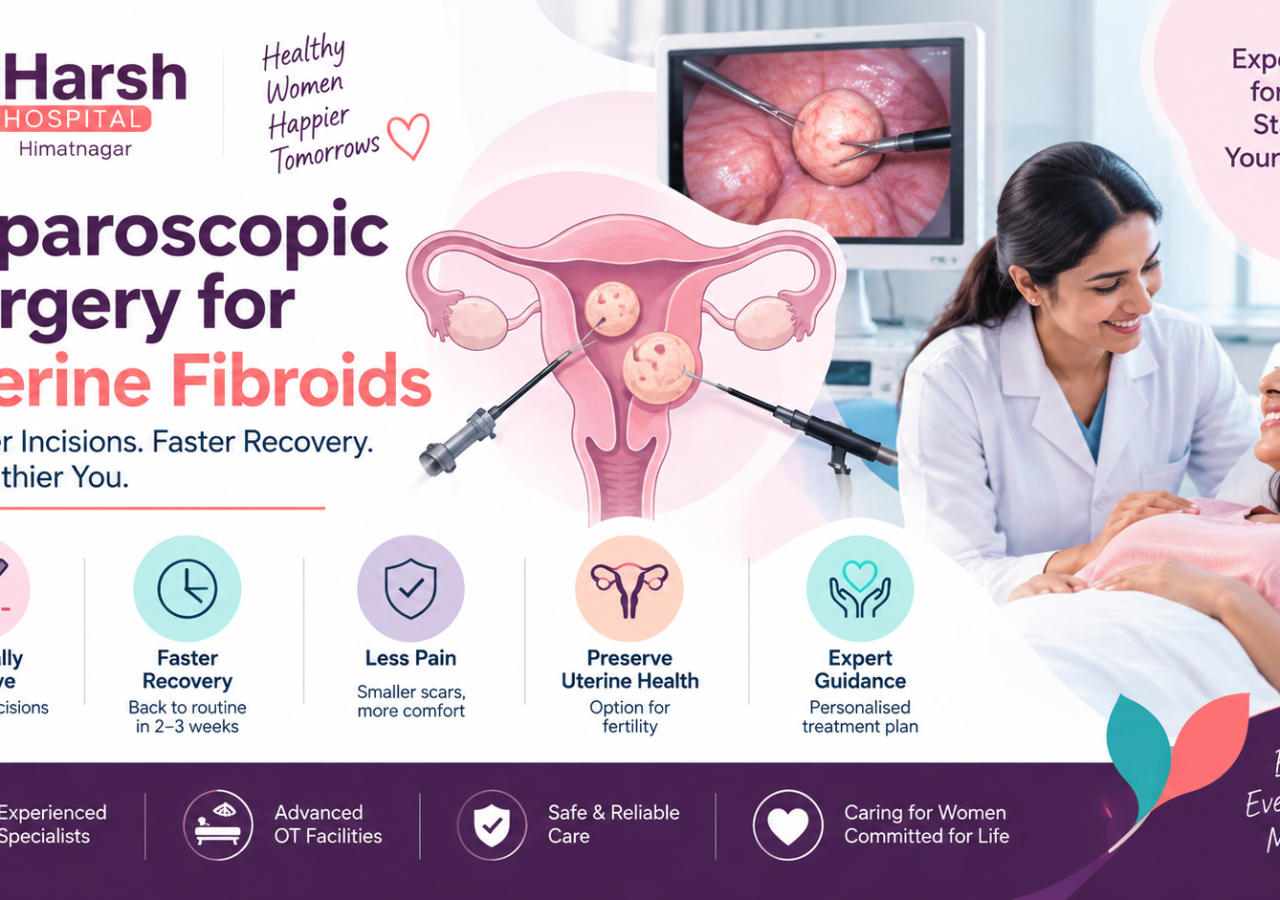
Laparoscopic fibroid surgery uses 3 or 4 incisions of 0.5 to 1.2 cm, with a hospital stay of 1 to 2 days and return to routine activity in about 2 to 3 weeks. Open surgery uses a single larger incision, needs 4 to 6 days in hospital and 4 to 6 weeks of recovery. Fibroid size, number and position decide which is safer.
Both forms of fibroid removal surgery take out the same fibroids. The difference is access, and access affects recovery far more than it affects the result. This comparison sets out where each approach fits, and what to ask a surgeon before you choose. You can also read about laparoscopic hysterectomy if that option has been raised.
What Does a Laparoscopic Surgeon for Uterine Fibroids in Gujarat Actually Do?
Uterine fibroids are benign muscular growths of the uterus, and most need no treatment at all. They are common, often symptomless, and only need treatment when they cause heavy bleeding, pressure symptoms, pain or fertility problems.
When surgery is indicated, there are two main operations. A myomectomy is fibroid removal surgery that leaves the uterus in place, which matters if you want to preserve fertility. A hysterectomy removes the uterus and ends both the fibroids and the possibility of pregnancy. Either can be performed laparoscopically or open.
A laparoscopic surgeon for uterine fibroids in Gujarat performs these through small ports, using carbon dioxide to create working space and a camera for vision. Submucosal fibroids inside the cavity are often better removed hysteroscopically, through the cervix, with no abdominal incision at all.
Non-surgical uterine fibroid treatment comes first in many cases. Tranexamic acid, hormonal treatment and an intrauterine system can control bleeding without surgery. The Royal College of Obstetricians and Gynaecologists and ACOG both set out stepwise management that begins with the least invasive option that fits the symptoms.
Laparoscopic Surgeon for Uterine Fibroids in Gujarat: Comparison Table
| Factor | Laparoscopic surgery | Open surgery |
| Incisions | 3 to 4 ports, 0.5 to 1.2 cm | One incision, usually 10 to 15 cm |
| Hospital stay | 1 to 2 days typically | 4 to 6 days typically |
| Return to routine activity | About 2 to 3 weeks | About 4 to 6 weeks |
| Blood loss | Generally lower | Generally higher |
| Post-operative pain | Usually less, but shoulder tip pain from CO2 is common | Usually more, wound-related |
| Wound infection risk | Lower, smaller wounds | Higher, larger wound |
| Adhesion formation | Generally less | Generally more |
| Operating time | Often longer | Often shorter |
| Suited to | Fewer, smaller, accessible fibroids | Very large or numerous fibroids, dense adhesions |
| Anaesthesia | General anaesthesia | General or regional |
Figures above are typical ranges reported in gynaecological practice and vary with fibroid size, number, position and individual health. Your own recovery may differ.
Which Approach Does a Laparoscopic Surgeon for Uterine Fibroids in Gujarat Recommend?
Neither is universally safer, and any laparoscopic surgeon for uterine fibroids in Gujarat who says otherwise is oversimplifying. Safety depends on the fibroids and on you, which is why a laparoscopic surgeon for uterine fibroids in Gujarat should examine you and review imaging before recommending anything.
A laparoscopic surgeon for uterine fibroids in Gujarat will usually consider keyhole fibroid surgery for fewer than 4 or 5 fibroids, none larger than roughly 8 to 10 cm, in positions that can be reached. It also suits women with a body mass index that makes a large wound slow to heal, and those who need to return to work quickly.
Open myomectomy is often the safer choice with a very large uterus, with many fibroids scattered through the wall, with deep intramural fibroids needing multi-layer repair, or where previous surgery has left dense adhesions. It is also preferred when malignancy is suspected, because tissue can be removed intact.
The difficult middle ground is a bulky uterus in a woman who wants to preserve fertility. Here the quality of the uterine repair matters more than the size of the scar, because a poorly repaired uterus carries risk in a later pregnancy. An experienced laparoscopic surgeon for uterine fibroids in Gujarat will tell you honestly if an open myomectomy gives a better closure in your case.
What About Morcellation?
Removing a large fibroid through a small port requires cutting it into pieces, a process called morcellation. Every laparoscopic surgeon for uterine fibroids in Gujarat should raise this with you. If an unsuspected uterine sarcoma is present, morcellation can spread malignant tissue within the abdomen.
Sarcoma is rare, but it cannot be excluded reliably before fibroid removal surgery. Contained morcellation inside a retrieval bag, or a small extension of one incision, reduces the risk. Ask your surgeon directly how tissue will be removed, and confirm that everything removed goes for histopathology.
This is a genuine trade-off rather than a reason to avoid laparoscopy. It is also a good test of a laparoscopic surgeon for uterine fibroids in Gujarat: one who raises morcellation before you do is engaging with the real risks.
How Do You Choose a Laparoscopic Surgeon for Uterine Fibroids in Gujarat?
Ask for numbers. How many laparoscopic myomectomy procedures does the surgeon perform each year, and what proportion convert to open surgery? Volume in this specific operation is more informative than years in practice.
Ask what imaging was used. An ultrasound is usually enough, but MRI helps map multiple or deep fibroids and is worth requesting when the picture is unclear. A surgical plan made without adequate mapping is a plan that may change mid-operation.
Ask about the team and the hospital. A laparoscopic myomectomy can bleed. The theatre should have appropriate energy devices and access to blood products, and the anaesthetist should be experienced with prolonged pneumoperitoneum.
Ask about fertility. If you want to conceive, ask how the uterine wall will be repaired, in how many layers, and how long you should wait before trying. Recommendations vary, and a laparoscopic surgeon for uterine fibroids in Gujarat should give you a specific answer for your case.
Dr. Hitesh A. Patel at Harsh Hospital in Himatnagar has over 20 years of experience in gynaecology and advanced laparoscopy, and reviews every uterine fibroid treatment plan with imaging before advising on an approach. Second opinions on an existing surgical plan are welcome.
When You Should Not Have Fibroid Surgery at All
This is the section most surgical articles leave out, and it applies to many women who are told they need an operation.
Small fibroids causing no symptoms generally need no uterine fibroid treatment at all. Being told a 3 cm fibroid was seen on a scan is not an indication for surgery. Observation with periodic review is a legitimate plan.
Fibroids usually shrink after menopause as oestrogen falls. If you are close to menopause and your symptoms are manageable, waiting may avoid an operation entirely.
If bleeding is your main symptom and you have not tried medical management, fibroid removal surgery is premature. Tranexamic acid, hormonal treatment or an intrauterine system control bleeding for many women. The National Institute for Health and Care Excellence sets out this stepwise approach to heavy menstrual bleeding.
Be cautious if a laparoscopic surgeon for uterine fibroids in Gujarat recommends hysterectomy without discussing myomectomy, uterine artery embolisation or medical options. You should be offered a choice, not a single path.
Fibroid Surgery Recovery: What to Expect Either Way
Fibroid surgery recovery differs sharply between the two approaches. After keyhole fibroid surgery, most women are walking within hours and home in 1 to 2 days. Shoulder tip pain from residual carbon dioxide is common for 2 to 3 days and settles on its own. Driving usually resumes at 1 to 2 weeks, and desk work at around 2 weeks.
After an open myomectomy, expect 4 to 6 days in hospital and more wound pain. Lifting is restricted for about 6 weeks, which lengthens fibroid surgery recovery considerably. Return to work is typically 4 to 6 weeks depending on the job.
Both operations need the same vigilance. Fever, increasing pain, heavy bleeding, redness at a wound or difficulty passing urine warrant contact with your surgical team rather than waiting for the next appointment.
Speaking to a Laparoscopic Surgeon for Uterine Fibroids in Gujarat
If a laparoscopic surgeon for uterine fibroids in Gujarat has advised surgery, bring your scan reports and blood results to a second consultation and work through the questions above. You can book an appointment at Harsh Hospital in Himatnagar, read about Dr. Hitesh A. Patel, or explore related care for menstrual disorders if heavy bleeding is your main concern.
Frequently Asked Questions
Is keyhole fibroid surgery better than open surgery?
Not universally. Laparoscopy usually means less pain, a 1 to 2 day stay and 2 to 3 week recovery. Open surgery is safer with very large or numerous fibroids and dense adhesions. Fibroid size, number and position decide.
How large can a fibroid be for laparoscopic removal?
There is no fixed limit. A laparoscopic surgeon for uterine fibroids in Gujarat may consider keyhole surgery for fibroids up to roughly 8 to 10 cm, depending on number and position. A single accessible fibroid may be removable when several smaller ones are not.
Will fibroids come back after myomectomy?
New fibroids can develop after myomectomy, since the operation removes existing ones rather than the tendency to form them. Recurrence risk varies with age, number removed and how close you are to menopause. Hysterectomy prevents recurrence entirely.
Can I get pregnant after a laparoscopic myomectomy?
Often yes, and preserving fertility is a common reason to choose myomectomy over hysterectomy. Ask how the uterine wall was repaired and how long to wait before conceiving. Your obstetrician should know about the surgery when planning delivery.
Where can I find a laparoscopic surgeon for uterine fibroids in Gujarat?
Dr. Hitesh A. Patel at Harsh Hospital, Himatnagar, performs advanced laparoscopic gynaecological surgery in North Gujarat. Verify any surgeon’s State Medical Council registration and ask for their annual myomectomy numbers before booking.
Do all fibroids need surgery?
No. Uterine fibroid treatment is not always surgical, and small fibroids causing no symptoms usually need only periodic review. Fibroids often shrink after menopause. Medical treatment controls bleeding for many women, and surgery is generally considered when symptoms persist despite it.
What is morcellation and should I be worried?
Morcellation cuts a fibroid into pieces for removal through small ports. If an unsuspected sarcoma is present, this can spread cells. Contained morcellation in a bag reduces this risk. Ask any laparoscopic surgeon for uterine fibroids in Gujarat how tissue will be removed and tested.
Medical Disclaimer
This article provides general information and is not a substitute for individual medical advice. Treatment for uterine fibroids depends on your symptoms, imaging, fertility plans and overall health. Please discuss your options with a qualified gynaecologist.