
11/24/2026 · Gynaecology
Quick Answer: What Are the Treatment Options for Blocked Fallopian Tubes?
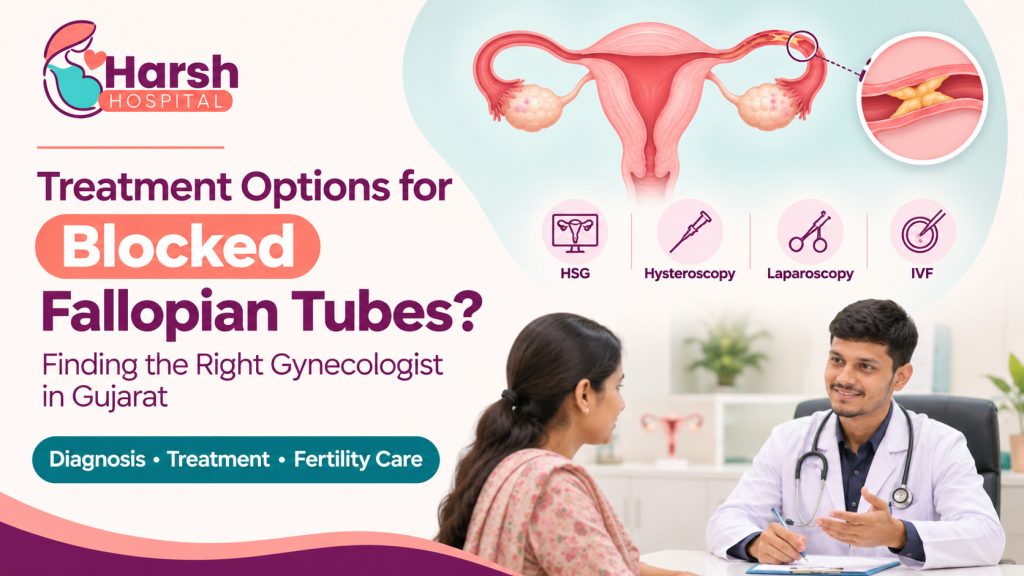
Treatment depends on the location and severity of the blockage, the woman’s age and her fertility goals. Options include medication for infection, hysteroscopic tubal cannulation, laparoscopic surgery to release adhesions or create a new tubal opening, and IVF when the tubes cannot be repaired. A qualified gynecologist for blocked fallopian tubes in Gujarat can confirm the type of obstruction before recommending a plan.
Difficulty conceiving after a year of regular, unprotected intercourse often prompts couples to seek medical answers, and in many women the explanation lies in the fallopian tubes. Families across North Gujarat look for a gynecologist for blocked fallopian tubes in Gujarat who can investigate thoroughly, explain findings in plain language and outline realistic tubal blockage treatment options without pressure. This guide explains how obstruction is identified, how treatments compare and how to choose a specialist. It reflects the evaluation approach followed at Harsh Hospital in Himatnagar, where tubal problems are assessed as part of a complete fertility work-up, and it offers a practical overview of blocked fallopian tubes treatment in Gujarat.
What Are Blocked Fallopian Tubes and Why Do They Affect Fertility?
The fallopian tubes are two narrow, muscular channels connecting the ovaries to the uterus. Each month an egg enters the tube, where fertilisation normally occurs, and the embryo then travels to the uterus. When a tube is partially or completely obstructed, sperm and egg may be unable to meet, or an embryo may be unable to travel safely.
A published NCBI review of tubal factors affecting fertility describes tubal obstruction as a common cause of infertility and identifies inflammation and infection as leading reasons for blockage. For this reason, infertility treatment due to blocked tubes begins with locating exactly where, and how, the tube is affected.
Blockages are classified by position: proximal (near the uterus), mid-segment, or distal (near the ovary). Distal obstruction may cause hydrosalpinx, a swollen, fluid-filled tube. Position matters because it largely determines which treatment a gynecologist for blocked fallopian tubes in Gujarat will consider suitable.
What Causes Fallopian Tube Blockage?
A gynecologist for blocked fallopian tubes in Gujarat will first look for an underlying cause. Commonly reported contributors include:
- Pelvic inflammatory disease (PID): infection, often following untreated sexually transmitted infections, can scar the tubal lining.
- Genital tuberculosis: a recognised cause of tubal damage in India that may produce few symptoms.
- Endometriosis: tissue resembling the uterine lining can create adhesions around the tubes.
- Previous pelvic surgery or ectopic pregnancy: both can leave scar tissue or a narrowed tube.
- Congenital differences or mucus plugs: some women have tubal abnormalities from birth.
Most women have no symptoms, so the condition is often discovered during an infertility evaluation. Some report pelvic pain, painful periods or abnormal discharge, but these overlap with many other conditions and only testing can confirm tubal involvement. A blockage is never the result of anything the patient did or failed to do.
How Is Fallopian Tube Blockage Diagnosed?
An accurate fallopian tube blockage diagnosis begins with history, examination and basic fertility tests, including ovulation assessment and the partner’s semen analysis, because infertility is frequently multifactorial. Tubal patency testing follows when a tubal cause is suspected, and a gynecologist for blocked fallopian tubes in Gujarat typically sequences these tests from least to most invasive.
According to Wikipedia’s overview of tubal factor infertility, obstruction can occur anywhere along the tube and may be partial or complete, and tubal spasm during dye injection can occasionally cause a misleading result. This is why findings are interpreted alongside the clinical picture.
What Is Hysterosalpingography (HSG)?
HSG is an outpatient X-ray in which contrast dye is introduced through the cervix to outline the uterine cavity and tubes. Free spill of dye from the tube ends suggests the tubes are open. It is a common first-line screening test.
What Is Laparoscopy With a Dye Test?
Laparoscopy allows direct visualisation of the pelvis through a small telescope while dye is passed through the tubes. It can reveal adhesions, endometriosis and hydrosalpinx that imaging may miss, and diagnosis and treatment can often be combined in one sitting.
How Do the Main Diagnostic Methods Compare?
| Diagnostic Method | What It Shows | Approach | Key Considerations |
| HSG | Uterine cavity and tubal patency | Outpatient X-ray with dye | Brief cramping; spasm may mimic blockage |
| Sonosalpingography | Tubal patency and pelvic structures | Ultrasound with contrast | No radiation; operator dependent |
| Laparoscopy with dye test | Tubes, adhesions, endometriosis | Keyhole surgery under anaesthesia | Most detailed; allows simultaneous treatment |
| Hysteroscopy | Uterine cavity and tubal openings | Telescope through the cervix | Useful for proximal evaluation |
What Are the Tubal Blockage Treatment Options?
The right tubal blockage treatment options depend on the site of obstruction, extent of damage, the woman’s age, ovarian reserve and duration of infertility. Patients seeking blocked fallopian tubes treatment in Gujarat should expect a plan tailored to these factors, not one standard procedure.
Can Medication Treat a Blocked Fallopian Tube?
Medication cannot reopen a scarred tube. However, antibiotics treat active pelvic infection and anti-tubercular therapy treats confirmed genital tuberculosis. Controlling infection prevents further damage and is often a first step.
What Is Tubal Cannulation?
For blockage near the uterine end, a thin catheter or guide wire is passed through the tube under hysteroscopic or radiological guidance to clear debris. Clinical guidance recognises catheterisation as an option for proximal obstruction after risks, benefits and alternatives such as IVF are discussed.
How Does Laparoscopic Surgery Help?
Laparoscopic surgery for blocked fallopian tubes uses small abdominal incisions, a camera and fine instruments. The surgeon may release adhesions (adhesiolysis), repair the tube end (fimbrioplasty) or perform neosalpingostomy, a form of fallopian tube opening surgery that creates a new opening in a closed distal tube. For a badly damaged hydrosalpinx, removal of the tube (salpingectomy) may be advised because the fluid can reduce IVF success.
Outcomes vary with the degree of damage. Mild distal disease generally responds better than severe scarring, and no surgeon can guarantee pregnancy, which is why a gynecologist for blocked fallopian tubes in Gujarat selects candidates carefully.
When Is IVF Recommended?
IVF bypasses the tubes by fertilising the egg in the laboratory and placing the embryo in the uterus. It is often considered when both tubes are severely damaged, surgery is unlikely to succeed, the woman is older or other fertility factors coexist. Choosing infertility treatment due to blocked tubes therefore means weighing repair against IVF after full evaluation, and a gynecologist for blocked fallopian tubes in Gujarat will usually raise this option early so couples can plan.
How Do Treatment Options Compare?
| Treatment | Best Suited For | Approach | Key Considerations |
| Antibiotics / anti-tubercular therapy | Active infection | Medication | Controls disease; does not reopen scarred tubes |
| Tubal cannulation | Proximal blockage | Hysteroscopic or radiological | Minimally invasive; selected cases only |
| Adhesiolysis / fimbrioplasty | Mild to moderate distal damage | Keyhole surgery | Allows natural conception; results vary |
| Fallopian tube opening surgery | Closed distal tube | Keyhole surgery | Reclosure possible |
| Salpingectomy | Severe hydrosalpinx | Keyhole surgery | Usually followed by IVF |
| IVF | Irreparable damage or combined factors | Laboratory fertilisation | Bypasses tubes; needs ovarian stimulation |
Why Choose a Gynecologist for Blocked Fallopian Tubes in Gujarat With Specialised Experience?
Tubal evaluation and surgery demand judgement as well as technical skill. A well-chosen blocked fallopian tube specialist in Gujarat recommends the least invasive effective option, sets realistic expectations and refers for IVF when it genuinely serves the patient. When selecting a gynecologist for tubal blockage, patients may consider:
- Training and experience: formal gynecology qualifications and experience in infertility evaluation and laparoscopy.
- Complete approach: assessment of ovulation, uterine and male factors, not only the tubes.
- Transparent counselling: clear discussion of risks and alternatives, without guaranteed outcomes.
- In-house facilities: imaging, hysteroscopy and laparoscopic theatres under one roof.
Choosing a gynecologist for blocked fallopian tubes in Gujarat on these criteria, rather than advertising alone, supports safer decisions.
How Does Harsh Hospital Approach Tubal Blockage?
Harsh Hospital is a gynecology, maternity and laparoscopic hospital in Himatnagar, led by Dr. Hitesh Patel, a gynecologist, obstetrician and laparoscopic surgeon with more than 20 years of experience. Women looking for a gynecologist for blocked fallopian tubes in Gujarat typically undergo a structured assessment: history, examination, hormonal evaluation and tubal patency testing when indicated, with findings explained to the couple. Our approach to fallopian tube blockage diagnosis relies on correlating tests rather than a single result.
Where laparoscopic surgery for blocked fallopian tubes or hysteroscopy is appropriate, it is performed in-house, so evaluation and selected treatment can be coordinated. Patients searching for a blocked fallopian tube specialist in Gujarat commonly ask whether tubes can be repaired or bypassed, how recovery affects daily routines and when to consider IVF. These are questions a good consultation should address openly, and every gynecologist for blocked fallopian tubes in Gujarat should be comfortable answering them.
When Should You Consult a Gynecologist for Blocked Fallopian Tubes in Gujarat?
Evaluation is advisable if:
- You have not conceived after 12 months of regular, unprotected intercourse, or six months if aged 35 or older.
- You have a history of pelvic infection, genital tuberculosis, endometriosis, ectopic pregnancy or abdominal surgery.
- You have persistent pelvic pain, severe period pain or abnormal discharge.
Seeing a gynecologist for tubal blockage early allows timely testing and can widen the available options.
Book a Consultation at Harsh Hospital
If you are trying to conceive and suspect a tubal problem, timely assessment can clarify your options. Consult Dr. Hitesh Patel at Harsh Hospital, Himatnagar, for a structured evaluation and honest discussion with a trusted gynecologist for blocked fallopian tubes in Gujarat. Book an appointment or call 99132 33538.
Conclusion
Blocked fallopian tubes are a common and often treatable contributor to infertility, but the right approach depends on cause, location and extent of damage. Careful diagnosis, honest counselling and a balanced choice between repair and IVF improve infertility treatment due to blocked tubes and support better-informed care. Choosing a gynecologist for blocked fallopian tubes in Gujarat with these standards matters. Whether you are exploring blocked fallopian tubes treatment in Gujarat or comparing a blocked fallopian tube specialist in Gujarat, prioritise complete evaluation and ethical guidance. With patient-centred care in North Gujarat, Harsh Hospital Himatnagar supports women and couples at every stage.
Frequently Asked Questions
What are the first signs of blocked fallopian tubes?
Many women have no signs. Some notice pelvic pain, painful periods or unusual discharge. Difficulty conceiving is often the first indication, so testing is the only reliable way to know.
How is fallopian tube blockage diagnosis done?
Doctors commonly use HSG, sonosalpingography, hysteroscopy or laparoscopy with a dye test. The choice depends on history and findings, and laparoscopy gives the most direct view of the tubes.
Can blocked fallopian tubes be treated without surgery?
In selected cases, yes, and a gynecologist for blocked fallopian tubes in Gujarat will confirm suitability first. Infection can be treated with medication and proximal blockages may be cleared by tubal cannulation. Scarring or hydrosalpinx usually needs surgery or IVF.
What is fallopian tube opening surgery?
It is a procedure such as neosalpingostomy that creates a new opening in a closed distal tube, usually by laparoscopy. Suitability depends on how healthy the tube remains.
Is laparoscopic surgery for blocked fallopian tubes safe?
It is widely used and generally well tolerated in trained hands. Like any surgery it carries risks such as infection, bleeding or organ injury, which should be discussed beforehand.
Can I get pregnant naturally with one blocked tube?
It may be possible if the other tube is healthy and ovulation is normal. A gynecologist for blocked fallopian tubes in Gujarat can assess both tubes and advise on timing and further options.
When is IVF better than surgery for tubal blockage?
IVF is often considered when tubes are severely damaged, surgery is unlikely to help or the woman is older. It is a personalised decision made with your gynecologist for blocked fallopian tubes in Gujarat after evaluation.
How do I choose a gynecologist for blocked fallopian tubes in Gujarat?
Look for a qualified gynecologist for tubal blockage with infertility and laparoscopy experience, clear counselling and in-house diagnostics. Asking about the evaluation process helps you decide confidently.
About Harsh Hospital
Harsh Hospital is a women’s health, maternity and laparoscopic hospital in Himatnagar, North Gujarat, serving patients who need a gynecologist for blocked fallopian tubes in Gujarat, and offering gynecology, infertility evaluation, laparoscopic and hysteroscopic surgery and pregnancy care. Address: Near Mehta Petrol Pump, Himatnagar 383001, Gujarat. Timings: Mon–Sat, 9:00 AM – 8:00 PM; Sunday, emergencies only.
Disclaimer: This article is for general educational purposes and should not replace consultation with a qualified healthcare professional.