
July 7, 2026 · Pregnancy
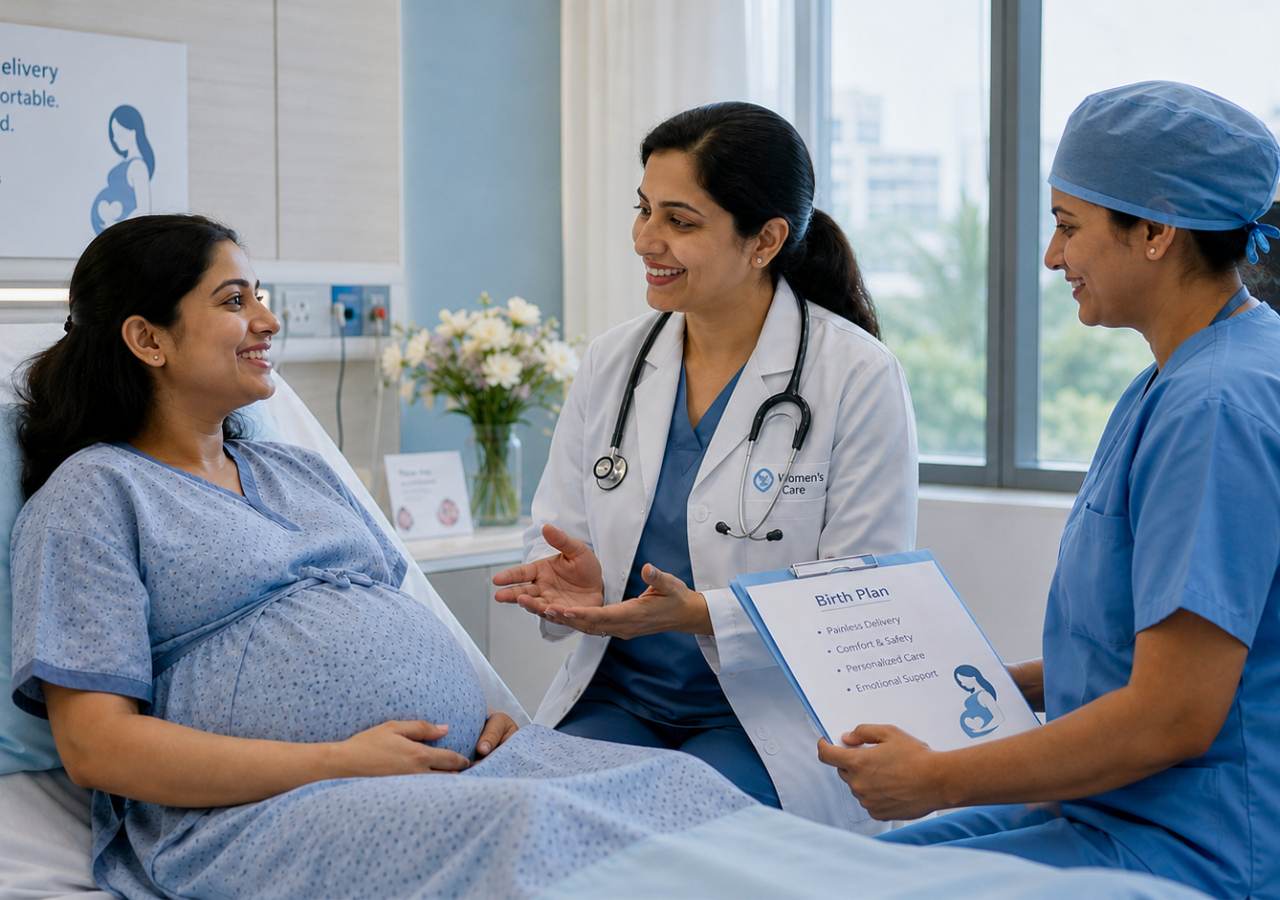
The word “labour” scares a lot of expecting mothers. That is normal. Most women in India ask the same thing at some point: can I have a normal birth without unbearable pain? Yes, you can. It is called painless delivery . At Harsh Hospital’s painless delivery team in Himatnagar, this option has helped hundreds of mothers stay calm through labour. An experienced anaesthesia team watches every step. This guide explains what the term means and how the epidural works. It also covers cost in India and how to decide if it fits your birth plan.
Painless delivery is a normal vaginal birth made easier with an epidural injection. The injection numbs labour pain. The mother stays fully awake. She can still push. There is no surgery involved.
What Is Painless Delivery?
Painless delivery is a normal, vaginal birth. It is supported by an epidural injection. The epidural blocks pain signals from the lower half of your body. So contractions feel like pressure, not sharp pain. You stay awake the whole time. So you can talk to your family. Also, you can hold your partner’s hand. And you push exactly when your doctor tells you to.
Some people confuse this option with a C-section. That mix-up causes needless worry. A C-section is major surgery. But this is still a normal birth. Only the pain relief changes. Doctors also call it “epidural analgesia” or “labour epidural.” Still, painless normal delivery is the term most Indian patients actually search for online.
How Does Epidural Painless Delivery Work?
An epidural painless delivery uses a thin catheter placed in your lower back. Here is what happens, step by step:
- First, your obstetrician confirms that labour has started. This usually happens once your cervix opens to about 4 to 5 cm.
- Next, an anaesthesiologist cleans your lower back. A local numbing shot goes in first, so the next step barely hurts.
- After that, a thin catheter slides into the epidural space. This space sits just outside the membrane around your spinal cord.
- Then, pain-relief medicine flows through the catheter. The dose stays small and controlled.
- Within 10 to 20 minutes, sharp pain usually fades into a manageable pressure.
- Throughout, the team keeps adjusting the dose. So you stay comfortable but alert enough to push later.
Timing and dosage matter a lot here. That is why an epidural painless delivery needs a hospital with anaesthesia cover around the clock. A delivery room with just an on-call doctor is not enough.
When Is the Epidural Given During Labour?
Doctors usually wait until labour is well underway. Giving it too soon can slow contractions down. So your team checks your dilation, your baby’s position, and how well you are coping first. Then they decide the right moment together with you.
Painless Normal Delivery vs Normal Delivery Without Pain Relief
Both painless normal delivery and unmedicated normal delivery end the same way. Your baby still arrives through vaginal birth. But the experience during labour feels quite different.
- For example, in an unmedicated normal delivery, you feel the full force of contractions. Breathing techniques, movement, or your birth partner offer the only comfort.
- Meanwhile, in a painless normal delivery, an epidural cuts most of that pain. You stay awake and aware the entire time.
- So, recovery after either option is usually similar. The birth process itself does not change; only the pain relief route does.
- Some women worry that painless normal delivery will make birth feel distant. In practice, most mothers say they felt just as present, only calmer and less worn out afterward.
Neither choice is automatically better for every woman. Your health history and your pain tolerance matter most here. Let your doctor’s advice guide the final decision, not pressure from family or social media.
Benefits of This Approach to Childbirth
More mothers across Gujarat, and across India, now ask their gynaecologist about this option before their due date. Here is why:
- A big drop in labour pain, without losing awareness.
- Lower stress-hormone levels, which can keep both mother and baby calmer.
- More energy to push well during the final stage, since less pain means less exhaustion.
- Steadier blood pressure in mothers prone to high BP under stress.
- A calmer experience for first-time mothers who fear labour pain.
- A faster switch to emergency C-section if needed, since the epidural line is already in place.
Epidural pain relief is still far less common in India than in the West. In the United States, roughly 60 percent of mothers use it. In Indian hospitals, the share is much smaller. Cost worries, low awareness, and a shortage of round-the-clock anaesthesia staff at smaller centres all play a part.
Are There Any Risks or Side Effects?
No medical step is completely free of downsides. Honest counselling about painless delivery matters more than a polished sales pitch. Some mothers feel a brief drop in blood pressure. Others get a mild backache at the injection spot, or a bit of shivering. Also, labour’s second stage can sometimes run slightly longer. In rare cases, doctors then use a vacuum or forceps if pushing gets harder to manage once the lower body feels numb.
These effects are usually mild. They also pass quickly. Serious complications stay rare when a trained anaesthesiologist handles the procedure in a well-equipped hospital. That is exactly why your choice of hospital matters as much as your choice of pain relief.
Common Myths About Painless Delivery vs Facts
- Myth: Painless delivery always ends in a C-section. Fact: it stays a normal delivery. The epidural does not force surgery.
- Myth: The epidural medicine harms the baby. Fact: the dose stays small and local. It does not meaningfully reach the baby in a harmful way.
- Myth: You cannot feel or push once the epidural goes in. Fact: you keep enough feeling to push well. The epidural cuts pain, not all sensation.
- Myth: Painless normal delivery only suits high-risk pregnancies. Fact: most healthy mothers can request it too, after a quick chat with their doctor.
Who Can Opt for Painless Normal Delivery?
Most healthy women in active labour can ask for an epidural painless delivery. Doctors often suggest it for first-time mothers. They also suggest it for women with a lower pain threshold. Anyone whose fear of labour pain affects their whole pregnancy can ask for it too. However, doctors usually avoid it for certain groups. This includes women with bleeding disorders, active spine infections, very low blood pressure, or specific nerve conditions. Your gynaecologist and anaesthesiologist review your reports together first. Then they confirm if you are a good fit.
How Much Does an Epidural Birth Cost in India?
The epidural part of a normal delivery in India usually costs ₹5,000 to ₹20,000. The exact price depends on the hospital, the city, and how long labour lasts. This charge sits on top of your regular delivery package. That package already covers the doctor’s fee, room charges, and routine monitoring. Government hospitals sometimes charge less, or bundle it into subsidised schemes. Private hospitals price it based on facilities and their anaesthesia team’s availability.
A few things push the final bill up or down. A longer hospital stay adds cost. So does a private or semi-private room instead of a general ward. Extra monitoring for you or your baby can add more. Before you pick a hospital, ask for a written estimate. It should clearly separate the delivery package cost from the epidural charge. This kind of clarity protects you from surprise bills later. It also helps you compare packages fairly across hospitals in your city.
How to Prepare for a Comfortable, Pain-Free Delivery
A little planning goes a long way. Try these steps:
- Bring up this option with your gynaecologist by your third trimester. Do not wait until admission day.
- Ask if the hospital keeps an anaesthesiologist on site round the clock. Epidurals cannot wait for someone to drive in from outside.
- Pack your hospital bag early. You do not want to rush once labour starts.
- Practice slow breathing and relaxation. These still help, even with an epidural in place.
- Talk with your partner or family about your birth plan. Everyone should know what to expect on the day.
- Get the total estimated cost in writing, including the epidural charge, before you get admitted.
Choosing the Right Hospital for Your Epidural Birth in Himatnagar
Not every maternity hospital runs epidural services around the clock. So this is one of the first things to check while hospital-hunting. Look for a dedicated obstetrician and an anaesthesiologist on call at all hours. The labour ward should also be ready for both normal delivery and emergency C-sections. That way, a sudden change in plan never means a change of hospital mid-labour.
At Harsh Hospital, Dr. Hitesh Patel and his team have guided thousands of deliveries in Himatnagar. In fact, epidural-supported normal delivery is offered as a standard option here for mothers who want it. Wondering why a well-equipped local hospital often beats a long trip to a bigger city for your birth? Our detailed post on choosing a normal delivery hospital in Himatnagar walks through the practical reasons families choose to stay close to home.
Does your pregnancy need extra monitoring? Then check the hospital’s high-risk pregnancy care services in advance. Do this even if you expect a straightforward birth. Planning your delivery in Himatnagar? Book a consultation with Dr. Hitesh Patel to talk through whether this option fits your birth plan. Get a clear, written cost estimate well before your due date.
Key Takeaways
- The birth stays vaginal. Only the pain relief changes.
- You stay awake. You can still push and hold your baby right after birth.
- Most healthy mothers qualify. Your doctor confirms this closer to your due date.
- Budget ₹5,000 to ₹20,000 extra for the epidural itself.
- Pick a hospital with round-the-clock anaesthesia cover, not just a labour room.
Conclusion
Painless delivery is not about skipping labour. It is about going through it without needless suffering, while staying alert enough to experience your baby’s birth fully. First, talk to your gynaecologist early. Then ask direct questions about cost and anaesthesia availability. Finally, choose a hospital that treats your comfort as seriously as your safety. Expecting in Himatnagar and want to explore your options? Harsh Hospital’s maternity team is happy to walk you through everything at a consultation.
Frequently Asked Questions
Is an epidural birth safe for both mother and baby?
Yes. A trained anaesthesiologist gives it in a properly equipped hospital. It stays safe for both mother and baby, and side effects are usually mild and short-lived.
Does epidural pain relief increase the chance of a C-section?
No. The birth stays a normal vaginal delivery. Choosing epidural pain relief does not, by itself, raise your chance of needing a C-section.
How much does the epidural option cost in India?
It usually costs ₹5,000 to ₹20,000 on top of your normal delivery package. The exact figure depends on your hospital and city.
Can I walk around after the epidural is placed?
Most hospitals ask you to stay in bed once it goes in. Your lower body has less feeling, so the nursing team watches your movement closely.
Will the epidural medicine affect my baby?
The medicine is given in small, local doses. So it does not meaningfully affect a baby during a healthy, well-monitored delivery.
At what stage of labour is the epidural usually given?
Doctors usually give it once labour is well underway, around 4 to 5 cm of cervical dilation. Your own doctor decides the exact timing on the day.
Can first-time mothers choose this kind of pain relief?
Yes. Many first-time mothers pick it for exactly this reason. They are unsure how they will cope with labour pain on their own.
Can I still request it close to my due date if I have not discussed it earlier?
It is best to raise this during your third trimester. But you can still ask your doctor at admission. Final availability depends on your condition and the hospital team on duty that day.