
June 24, 2026 · Gynaecology
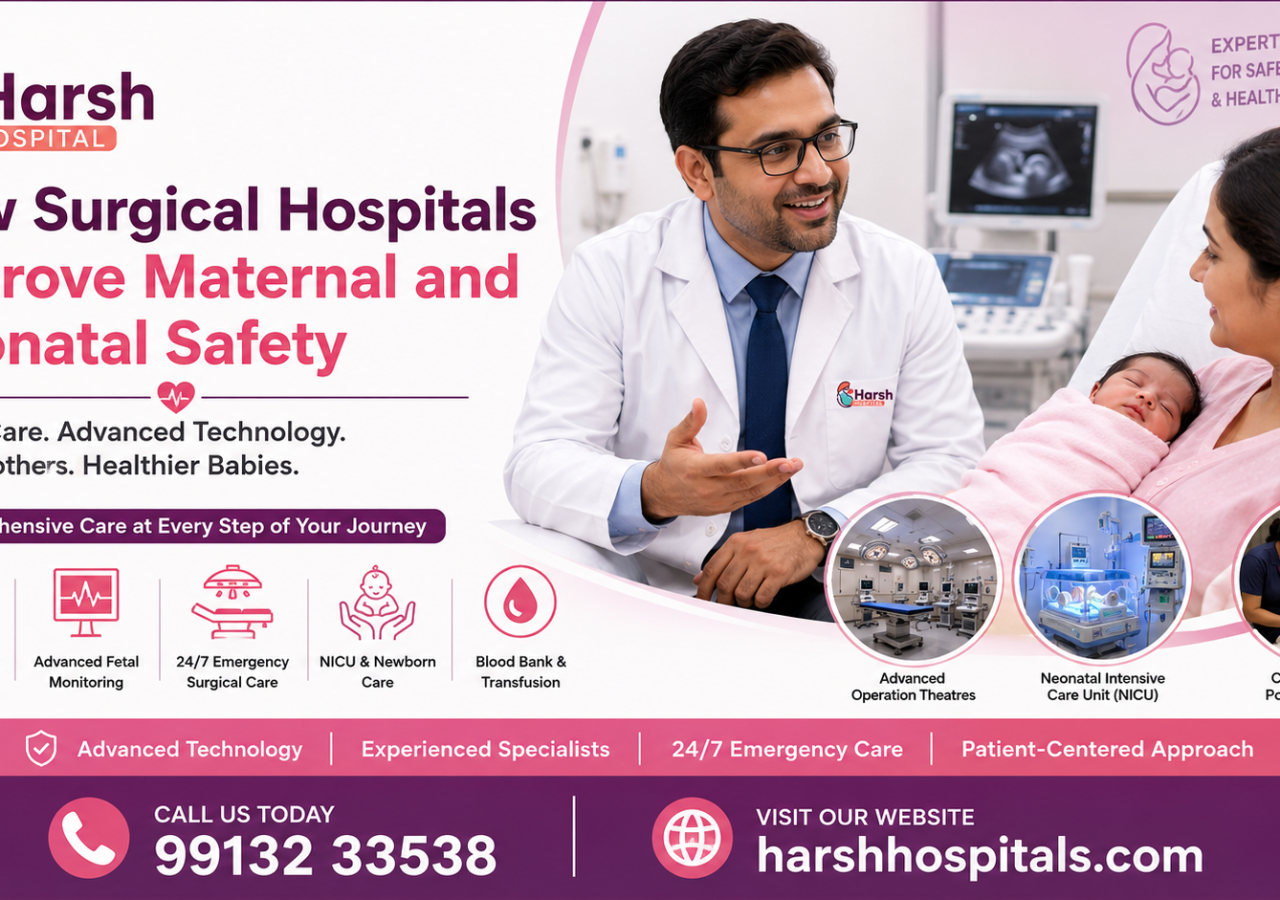
Every mother deserves a safe delivery, and every newborn deserves the best possible start in life. Yet the quality of care during pregnancy and childbirth depends enormously on where a mother chooses to deliver. A modern surgical hospital does far more than provide a bed and a delivery room it is a complete medical environment where trained specialists, advanced technology, and emergency systems work together to protect both mother and baby at every critical stage.
At Harsh Hospitals, we believe that access to the right surgical hospital is one of the most important factors in ensuring safe childbirth. Today’s families expect continuous fetal monitoring, experienced obstetricians, emergency surgical readiness, and neonatal intensive care — all under one roof. This article explains exactly how a surgical hospital actively reduces maternal and neonatal risks and why it sets the gold standard in modern maternity care.
Why Maternal and Neonatal Safety Is a Global Healthcare Priority
Childbirth carries genuine medical risk. Conditions like postpartum hemorrhage, preeclampsia, obstructed labour, and neonatal asphyxia can escalate from manageable to life-threatening within minutes. Most of these emergencies are preventable — but only when mothers are cared for in a properly equipped facility with the right people and tools in place.
Research consistently shows that access to a dedicated surgical hospital reduces rates of maternal and neonatal mortality. When emergency obstetric care, blood transfusion services, and advanced fetal monitoring are immediately available, outcomes improve dramatically. Increasingly, families seek facilities with proven expertise and round-the-clock surgical readiness — because where you deliver matters as much as how.
What Makes a Surgical Hospital Different From a General Hospital?
Many families assume any hospital can safely manage a delivery. While general hospitals provide essential care, a dedicated surgical hospital delivers critical advantages that directly improve outcomes for mothers and newborns.
Specialized Infrastructure
A surgical hospital is purpose-built around precision and patient safety. High-definition operation theatres support complex procedures including cesarean delivery and gynecological surgery, all within a rigorously controlled infection-prevention environment.
Trained Specialists
Expert obstetricians, gynecological surgeons, anesthesiologists, and neonatologists work together as one coordinated team. Meet our specialist doctors who lead every aspect of maternity care.
Emergency Preparedness
When complications arise without warning, clinical teams in a specialized facility respond within minutes — not hours — making life-saving decisions with clarity and confidence.
Modern Technology
From digital fetal monitoring to advanced laparoscopy and neonatal intensive care, the best-equipped facilities deploy technology specifically chosen for the most complex maternal and neonatal situations.
How Surgical Hospitals Reduce Maternal Risks During Pregnancy and Delivery
Maternal risk does not begin in the delivery room — it can be present from the earliest weeks of pregnancy. A surgical hospital addresses these risks systematically at every stage of care.
Early Identification of High-Risk Pregnancies
Conditions such as gestational diabetes, hypertension, multiple pregnancies, or a previous cesarean delivery place a mother in the high-risk category. Specialist teams identify these cases early through routine screening, advanced ultrasound imaging, and comprehensive blood investigations, then design tailored antenatal care plans to minimize complications at delivery.
Continuous Monitoring During Labour
Labour is the most dynamic and unpredictable phase of childbirth. A surgical hospital uses electronic fetal monitoring systems to track fetal heart rate and contractions in real time, triggering an immediate clinical response at the first sign of fetal distress. Our obstetrics team ensures every labour is monitored with rigorous care.
Rapid Emergency Surgical Intervention
Placental abruption, umbilical cord prolapse, and severe preeclampsia demand immediate surgical response. Fully staffed operation theatres enable emergency cesarean delivery within the critical time window that protects both mother and baby — a capability that truly distinguishes a surgical hospital from a standard maternity unit.
Advanced Blood Management and Critical Care
Postpartum hemorrhage remains a leading cause of preventable maternal death. Dedicated blood bank facilities and trained transfusion teams ensure that severe blood loss is managed rapidly, reducing the risk of maternal mortality from bleeding complications.
How Surgical Hospitals Improve Neonatal Safety
The moments immediately following birth are among the most vulnerable in a baby’s life. A surgical hospital ensures that expert newborn care is available from the very first breath.
Immediate Newborn Assessment
At every delivery, trained neonatologists conduct a systematic APGAR assessment and respond instantly to any signs of distress, oxygen deprivation, or developmental concern. Early identification means early intervention — and dramatically better outcomes.
Neonatal Resuscitation Readiness
Some babies are born not breathing or with a very slow heart rate. Dedicated resuscitation stations in every delivery area, staffed by neonatal teams ready to act within seconds, save lives that would otherwise be lost.
Infection Prevention Protocols
Newborns have immature immune systems, making them highly vulnerable to hospital-acquired infections. Strict hand hygiene standards, sterile equipment protocols, environmental sanitation, and controlled visitor access protect every baby in our care.
Specialized Support for Premature Babies
Premature infants born before 37 weeks require incubators, respiratory support, nutritional therapy, and continuous monitoring. A fully equipped neonatal intensive care unit provides all of this, giving even the smallest newborns the best possible chance of a healthy life.
What Technologies Improve Maternal and Neonatal Outcomes?
A modern surgical hospital relies on a combination of advanced technology and specialized expertise to deliver superior outcomes for mothers and babies. Our laparoscopy services reflect this commitment to minimally invasive, advanced surgical care. The table below highlights key technologies and their benefits:
| Technology | Benefit for Mother | Benefit for Baby |
| Electronic Fetal Monitoring | Early detection of labour complications | Continuous fetal heart rate tracking |
| Digital Ultrasound Imaging | Real-time placenta and fluid assessment | Accurate fetal growth monitoring |
| Advanced Laparoscopy | Minimally invasive surgery, faster recovery | Reduces surgical complication risk |
| Neonatal Intensive Care Unit (NICU) | Expert neonatal support on-site | Specialized care for premature newborns |
| Blood Bank & Transfusion Services | Immediate access during hemorrhage | Supports neonates needing transfusions |
| High-Definition Operation Theatre | Precision surgical setting for C-sections | Fully sterile conditions at birth |
| Pulse Oximetry & Vital Monitors | Continuous maternal BP and oxygen checks | Tracks newborn oxygen post-delivery |
Why Choosing the Right Facility Matters for Maternity Care
The facility you choose for your delivery shapes your entire birth experience. A surgical hospital that specializes in maternity care offers a level of safety and expertise that a general facility simply cannot replicate. When evaluating your options, look for these defining features:
- Experienced obstetricians managing both routine and high-risk pregnancies
- Advanced operation theatres equipped and ready for emergency cesarean delivery and gynecological surgery
- A fully functional NICU with dedicated neonatal staff available at all times
- 24/7 emergency response systems and immediate surgical access
- Rigorous infection control standards across all clinical areas
- Patient-centered care with transparent communication and family involvement
Each of these elements is a defining feature of a quality surgical hospital — and each contributes meaningfully to safer outcomes for both mother and baby.
Why Patients Prefer a Surgical Hospital in Himatnagar for Maternity Care
For families across North Gujarat, access to a quality surgical hospital in Himatnagar has transformed maternity care. Previously, complex pregnancies required exhausting travel to larger cities adding stress, cost, and dangerous treatment delays.
Today, a modern surgical hospital in Himatnagar provides the same specialized expertise and infrastructure that families once had to travel far to access. Skilled obstetricians, digital fetal monitoring, emergency operation theatres, and neonatal intensive care are all available locally. Key advantages include:
- Local accessibility that eliminates life-threatening travel delays during obstetric emergencies
- Advanced women’s healthcare capabilities including gynecological surgery and obstetric care
- Experienced surgeons and obstetricians dedicated to maternal and neonatal safety
- Modern infrastructure purpose-built for complex maternity and surgical cases
For the communities it serves, a surgical hospital in Himatnagar is not just a convenience it is a meaningful advancement in safe, accessible childbirth.
How a Women’s Surgical Hospital in Gujarat Supports Safer Deliveries
Gujarat has made significant strides in women’s healthcare. A dedicated women’s surgical hospital in Gujarat focuses exclusively on the medical, surgical, and emotional needs of women creating an environment uniquely suited to maternal and neonatal care. Explore our gynecology services to see how this commitment extends across every specialty.
At a women’s surgical hospital in Gujarat, comprehensive maternity services operate under one roof — from preconception counseling and high-risk pregnancy management through to surgical delivery and postpartum care. Gynecological surgery, including advanced laparoscopy, is led by specialists with deep expertise in women’s health. Neonatal care is equally specialized, with NICU teams trained to support the most vulnerable newborns.
For families seeking a women’s surgical hospital in Gujarat that combines advanced surgical capability with compassionate, patient-centered care, Harsh Hospitals is a trusted partner. Learn more about our values on our About Us page.
What Questions Should You Ask Before Choosing a Surgical Hospital?
What emergency facilities are available?
Ask about operation theatre availability, blood bank access, anesthesia support, and critical care units. In any properly equipped surgical hospital, these must be available around the clock not on request.
Who manages high-risk pregnancies?
Confirm that the facility has dedicated obstetricians experienced in gestational diabetes, preeclampsia, and multiple gestations. The expertise of the medical team is often the single most important factor in maternal safety outcomes.
How is newborn care handled after delivery?
A facility with an in-house NICU and on-call neonatologists offers far greater neonatal safety than one that transfers sick newborns elsewhere. Confirm that newborn care is co-located with the delivery suite for maximum speed in emergencies.
When should a mother consider a higher-level facility?
Mothers with complex medical histories, previous cesarean deliveries, or identified pregnancy complications should choose a surgical hospital from the very start of antenatal care — not only when problems arise.
Why does surgical expertise matter during childbirth?
Even apparently routine deliveries can require sudden surgical intervention. Choosing a facility where expert surgeons are already on-site — not being called in — is one of the most important safety decisions a family can make.
Conclusion
Choosing where to deliver your baby is one of the most consequential healthcare decisions you will make. A well-equipped surgical hospital offers far more than a delivery room it provides a complete ecosystem of expertise, technology, and emergency readiness that protects both mother and baby throughout the entire birth journey.
From the early identification of high-risk pregnancies to rapid emergency intervention, neonatal resuscitation, and rigorous infection control, every element of a surgical hospital is specifically designed to reduce risk and improve outcomes. For families in North Gujarat, Harsh Hospitals brings world-class maternity care within reach.
At Harsh Hospitals, we are proud to offer the expertise and infrastructure that every family deserves. To learn more or to book a consultation, please contact us today because every mother and every baby deserves the very best care from the very first moment.
Frequently Asked Questions (FAQ)
1. What defines a specialized maternity care facility?
It is a specialized medical facility with advanced operation theatres, trained surgeons, anesthesiologists, and emergency care systems providing a higher standard of readiness and infrastructure than a general hospital, making it uniquely suited for complex maternity and gynecological care.
2. Why is a surgical hospital important for maternity care?
Emergency operation theatres, experienced obstetricians, and neonatal intensive care are available around the clock. This significantly reduces the risk of preventable complications, particularly during high-risk pregnancies or unexpected delivery emergencies requiring immediate surgical response.
3. How do these facilities improve neonatal safety?
They improve neonatal safety through immediate APGAR assessment, on-site resuscitation teams, NICU facilities for premature babies, and strict infection prevention protocols ensuring every newborn receives expert care from the very first moments of life.
4. Can such a hospital handle high-risk pregnancies?
Absolutely. Dedicated obstetricians monitor complex conditions such as gestational diabetes, preeclampsia, and multiple gestations, with emergency cesarean delivery and intensive care immediately available whenever they are needed.
5. What should I look for in a maternity facility?
Prioritize experienced obstetricians, advanced operation theatres, a functional NICU, 24/7 blood bank access, emergency response systems, digital fetal monitoring, rigorous infection control, and a compassionate, patient-centered approach to women’s healthcare.
6. Why choose maternity care in Himatnagar?
Accessing a quality surgical hospital in this region offers advanced maternity care close to home for North Gujarat families. It removes the risk of travel delays during emergencies while offering skilled specialists, modern infrastructure, and comprehensive women’s healthcare — all locally accessible.
7. How does Gujarat’s women’s maternity care support mothers and babies?
Women’s health facilities in Gujarat designed specifically for maternity care offer the full spectrum of services — from high-risk pregnancy management to surgical delivery and specialized neonatal care — ensuring both maternal safety and newborn wellbeing remain the priority.